
Budget 2026: The Blue Economy — From Coastline to Production Line
₹5,164.8 crore for maritime sovereignty. Ports must evolve into self-contained economic cities that host the entire value chain.
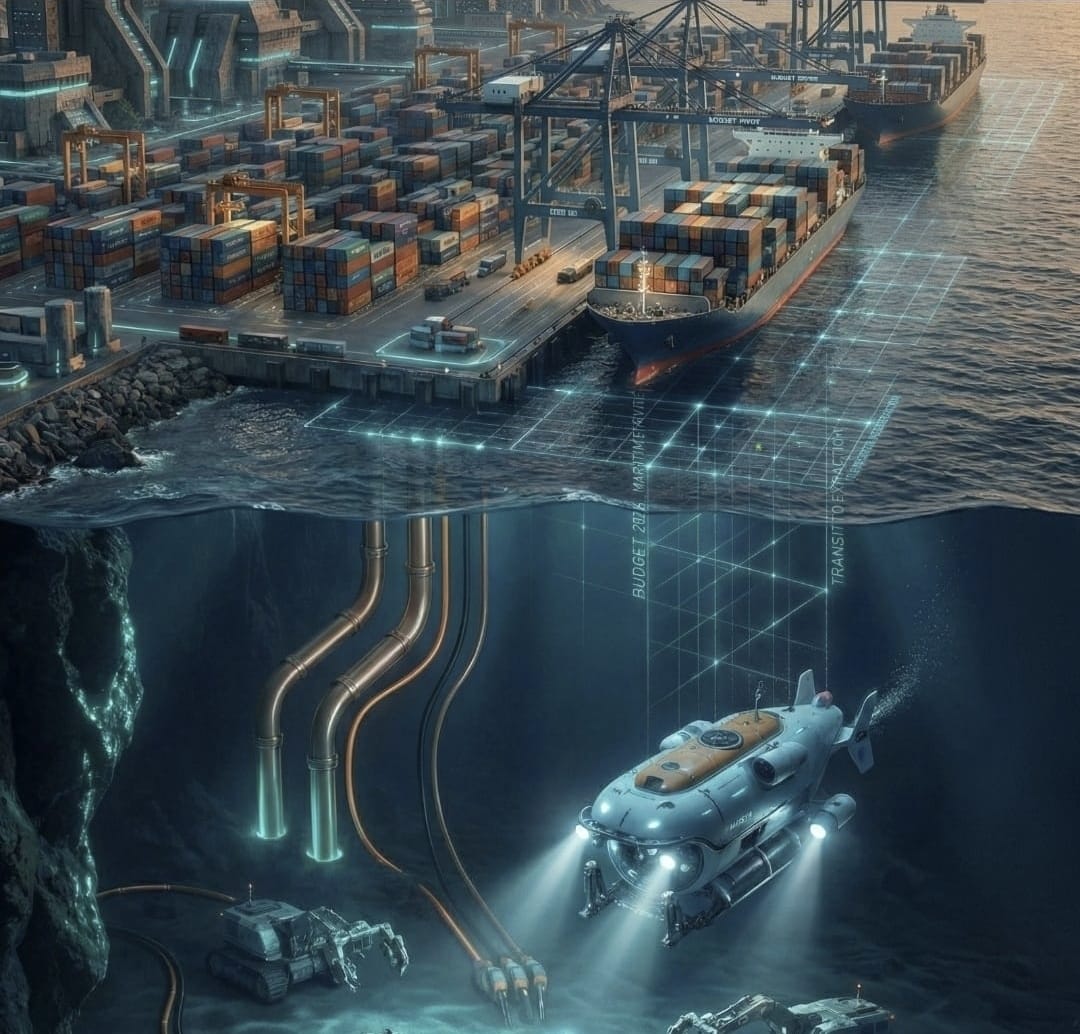
The Indian coastline is an economic continent in itself. Spanning 7,500 kilometres, it anchors our energy security and trade velocity, yet for decades we have treated it merely as a boundary rather than a factory. The vision has finally shifted. Ports must now evolve into self-contained economic cities that host the entire value chain—from ship repair to subsea mining. The ocean floor holds the minerals for our tech transition while the surface carries our exports. This sector is no longer about geography; it is about industrial sovereignty. The Budget 2026 numbers confirm the shift.
The Fiscal Anchor: ₹5,164.8 Crore and the New Maritime Doctrine
Budget 2026 backs this vision with hard cash. The Ministry of Ports, Shipping and Waterways receives ₹5,164.8 crore, a massive 48% increase over previous estimates that signals a serious intent to scale. The Maritime Development Fund (MDF) debuts with a ₹1,000 crore corpus to provide low-cost capital for indigenous shipbuilding. The fisheries sector sees a record allocation of ₹2,761.80 crore, anchored by the Pradhan Mantri Matsya Sampada Yojana. But the most significant structural move is the Container Manufacturing Scheme—a ₹4,166 crore incentive to manufacture one million TEUs (Twenty-foot Equivalent Units) on Indian soil. We must stop leasing the containers of global trade and start owning them. Finally, the Shipbuilding Development Scheme gets ₹250 crore for modernisation, complemented by the revival of Ship Repair Clusters in strategic inland waterway hubs.
From Raw Catch to Value Chain: The Hardware Imperative
We are finally building hardware. The container scheme aims to create an annual capacity of one million Twenty-foot Equivalent Units (TEUs), creating a buffer that protects Indian exporters from freight rate spikes and secures our supply chain. The increase in duty-free import entitlements for seafood processing inputs—from 1% to 3%—changes the export game entirely. We stop selling raw catch and start selling premium, processed brands to the EU and Japanese markets. Value addition is the weapon. Meanwhile, the thrust on inland waterways is meant to create a parallel freight corridor that reduces road damage and carbon emissions. All of this combined represents a shift from coastline management to coastline manufacturing.
The Execution Drag: Channels, Skills, and Regulatory Friction
Money cannot fix everything immediately. Our channels are often too shallow for ultra-large vessels and dredging capacity remains a significant bottleneck. We also face a severe skills gap; while we have the labour, we lack certified marine welders and naval architects to build at global standards. The Deep Ocean Mission needs faster technology transfer. Subsea mining is high-risk and private capital remains wary of the long gestation periods. Regulatory clearances for coastal zone development continue to be labyrinthine. The container scheme must prove that it can compete on price with Chinese manufacturers, who still dominate 95% of global container production. Each of these represents a friction point that could slow the capital-to-capacity translation.
The Private Sector Playbook: Speed Over Perfection
The private sector must move fast. Do not wait for policy perfection. Use the MDF to underwrite joint ventures with Korean or Japanese shipyards and leverage the Shipbuilding Development Scheme's ₹250 crore allocation to modernise existing yards. Focus on "brownfield expansion" for speed. The immediate profit lies in the Container Manufacturing Scheme. Set up units near major ports like Mundra or JNPT and tap into the Ship Repair Clusters planned for Varanasi and Patna. Inland waterway logistics is an untapped market. Firms that move first to establish barge services on NW-1 and NW-2 will create a lasting competitive moat.
The Maritime Sovereignty Roadmap
The roadmap for the coming fiscal year is about establishing total maritime sovereignty. We must move from connectivity to self-reliance where domestic containers carry domestic goods. The priority is to operationalise 20 new National Waterways, starting with NW-5 in Odisha, to link mines directly to ports and reduce logistics costs. Simultaneously, we need to make the Exclusive Economic Zone (EEZ) a duty-free zone for Indian vessels to encourage deep-sea trawling. The final frontier is the seabed. Fast-tracking the Deep Ocean Mission's mining component will determine whether India joins the club of nations that control the minerals powering the 21st-century industrial base.
Solutions Spotlight
The government must use the MDF to offer First-Loss Default Guarantees. This will encourage private lenders to back high-risk shipbuilding projects. We need a "Blue Skill Mission" at all major coastal polytechnics to train the workforce for the yards of tomorrow.
Strategy Note
India Front identifies the container scheme as the critical intercept. Control the box, and you control the trade. The winners of 2026 will be the firms that build the hardware of global trade, not just the ones booking space on foreign ships.
Key Takeaway
The Blue Economy is no longer optional; it is strategic. Budget 2026 provides the capital, but the industry must now provide the execution. The India Edge lies in mastering the depths and securing the shipping lanes through ruthless domestic manufacturing.
Rishi Vora
Founder and Editor, India Front