
Budget 2026: Mining the Future
₹15,000 crore for the National Critical Minerals Mission. Pivoting from oil wells to lithium brine as the new definition of energy security.
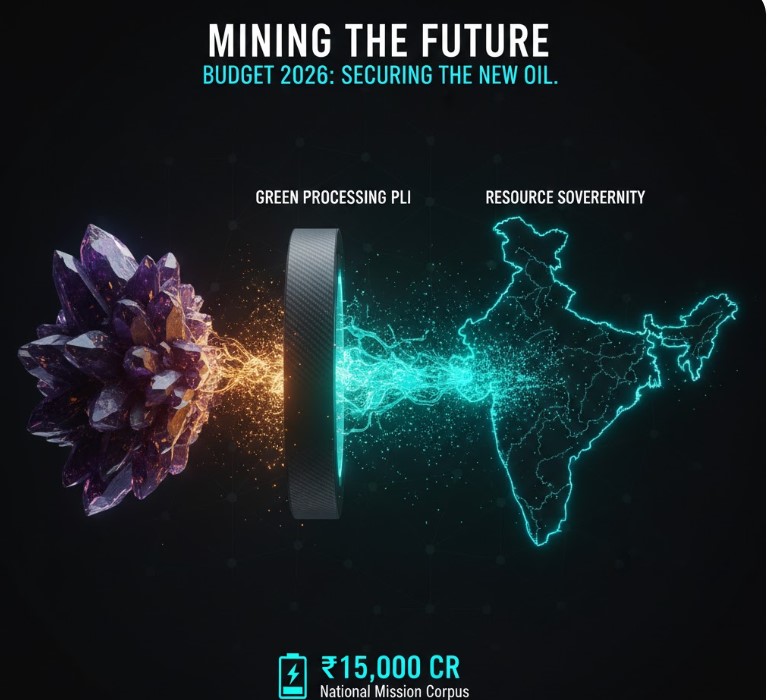
For two years, the industry waited for the roadmap. Budget 2026 finally delivered the cheque. The headline figure is the ₹15,000 crore corpus earmarked specifically for the National Critical Minerals Mission. Strategic Resource Security has appeared for the first time as a distinct capital line item, separating it from general mining. The breakdown is tactical: ₹8,000 crore is dedicated to KABIL (Khanij Bidesh India Ltd) for immediate overseas asset acquisition, while ₹5,000 crore is directed towards "Green Processing PLI" to build domestic refining capacity. The remaining ₹2,000 crore is dedicated to exploration.
The Strategic Opportunity
The allocation changes the conversation from anxiety to action. We have successfully funded the Gigafactories to build electric vehicles, but we had not secured what goes inside them. By capitalising the acquisition fund, we are pivoting the definition of energy security from owning oil wells in the Gulf to owning lithium brine in Latin America. The opportunity is to transform India from a vulnerable importer of finished cells into a fortress of mineral processing, creating a new value chain where we import the raw ore and export the refined cathode.
Strategic Verdict
We endorse the urgency of the mission. The "Inverted Duty Structure" correction—reducing the Basic Customs Duty (BCD) on raw ores to 0% while retaining tariffs on finished cathodes—is the masterstroke. Such a policy forces global miners to send their dirt to India for cleaning. Speed of deployment, however, is the variable that matters. The global race for resources is already advanced, with competitors having locked in long-term offtake agreements years ago. The window is open, but it is narrowing with each quarter.
The Execution Roadmap
Money alone won't solve the problem. You need relationships on the ground. We need to start treating our mining majors less like contractors and more like strategic envoys. The best way to execute the strategy is through a Consortium Approach. A single Indian miner usually doesn't have the balance sheet to outbid a global giant in Chile or Australia. But if you put three Indian heavyweights together, backed by the new KABIL sovereign guarantee, the math changes completely. The fund should immediately be deployed to close at least two strategic offtake agreements by Q3 2026.
The Unified Execution Command
The Ministry of Mines and the Ministry of External Affairs must now operate as a single strategic unit. We have to move their focus beyond traditional cultural ties. Their primary mission now is the acquisition of mineral rights. Simultaneously, the private sector must invest heavily in Urban Mining. We should stop looking exclusively underground for our next lithium source. Our recycling centers are essentially high-grade mines waiting to be tapped. The circular economy for batteries is the domestic supply chain we already have.
Solutions Spotlight
To bridge the processing gap, the state should use the new fund to underwrite the initial CAPEX for private players setting up rare earth refineries, which are capital-intensive and energy-heavy. Additionally, we must leverage our Free Trade Agreements to ensure zero-duty imports of raw ore. Such a move positions India as the Refinery of the Global South, adding value to the resources of developing nations before they reach Western markets.
Key Takeaway
Budget 2026 has acknowledged the resource war. The India Edge depends on our ability to look beyond our borders for resources while building the technology to process them within our gates. We are not just mining rocks; we are excavating the foundation of our future economy.
Rishi Vora
Founder and Editor, India Front