
Budget 2026: Converting Science Capital into Industrial Sovereignty
₹1 lakh crore funds the scientific base, but the factory interface remains forgotten. Can we bridge the valley of death?
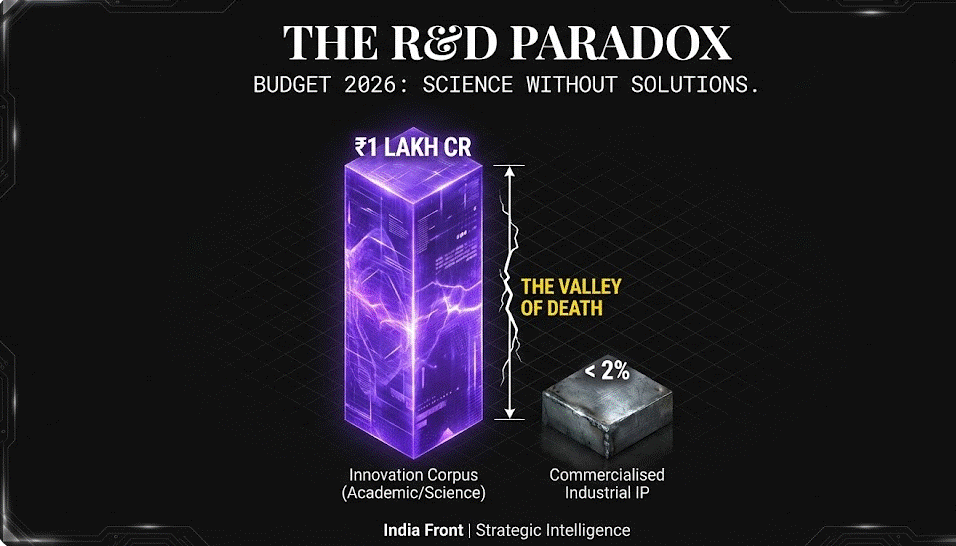
The headline figure is ₹1 lakh crore. To the layman, this appears to be a windfall. It is not. This is a financing corpus rather than a grant. It is a lever for debt rather than a cheque for discovery. When we contextualise the scale, the paradox becomes brutal because the annual R&D spend of a single American tech giant rivals our entire national innovation corpus. We are attempting to fund a superpower ambition with a budget that barely matches a corporate balance sheet. The strategic assessment must grapple with the tension between stated intent and structural reality.
Strategic Verdict
The intent towards technological sovereignty is undeniable, but the mechanism for delivery requires recalibration. The decision to route the bulk of innovation financing through university grants creates a disconnect. Deep Tech is not merely an academic pursuit; it is an industrial necessity. The current framework incentivises Safe Science which is research that guarantees a citation. It fails to adequately underwrite Hard Tech which involves engineering challenges that may fail. This dichotomy is strategic kryptonite. Academic comfort produces publications; industrial discomfort produces patents.
The Execution Roadmap
The transformation of this corpus from a grant mechanism into a commercial engine requires a new rule of engagement. The ₹1 lakh crore should not function as a loan to established conglomerates but must serve as risk capital for industrial consortiums. The path forward involves a three-stage integration. The first phase demands that heavy industry identifies Grand Challenges which are specific and high-value problems in material science, defence, or energy. The second phase channels the Research Fund directly into addressing these articulated challenges. The third phase requires creation of mandatory Offtake Agreements where solutions that work are immediately absorbed by national infrastructure projects.
The Unified Execution Command
The role of the state must evolve from patron to participant. The most effective catalyst for Deep Tech is not a subsidy but a purchase order. If a domestic firm engineers a superior battery chemistry, the state's most powerful lever is a procurement contract. For the private sector, the view on R&D must shift from Corporate Social Responsibility to strategic survival. The factory floor must become the sandbox for the startup. The validation of a technology in a running plant is worth more than a hundred academic trials.
Solutions Spotlight
The solution lies in the Lab-to-Land accelerator model. This requires specific zones called Deep Tech Parks where regulatory friction is minimised. The flow of capital should prioritise the acquisition of testing equipment and pilot lines over civil construction. The patent must be valued above the publication.
Key Takeaway
Budget 2026 has successfully capitalised the scientific base but has forgotten the factory interface. The India Edge depends on the ability to extract science from the campus and weld it into the backbone of the heavy engineering sector.
Rishi Vora
Founder and Editor, India Front