
Budget 2026: Converting Fiscal Power into Green Velocity
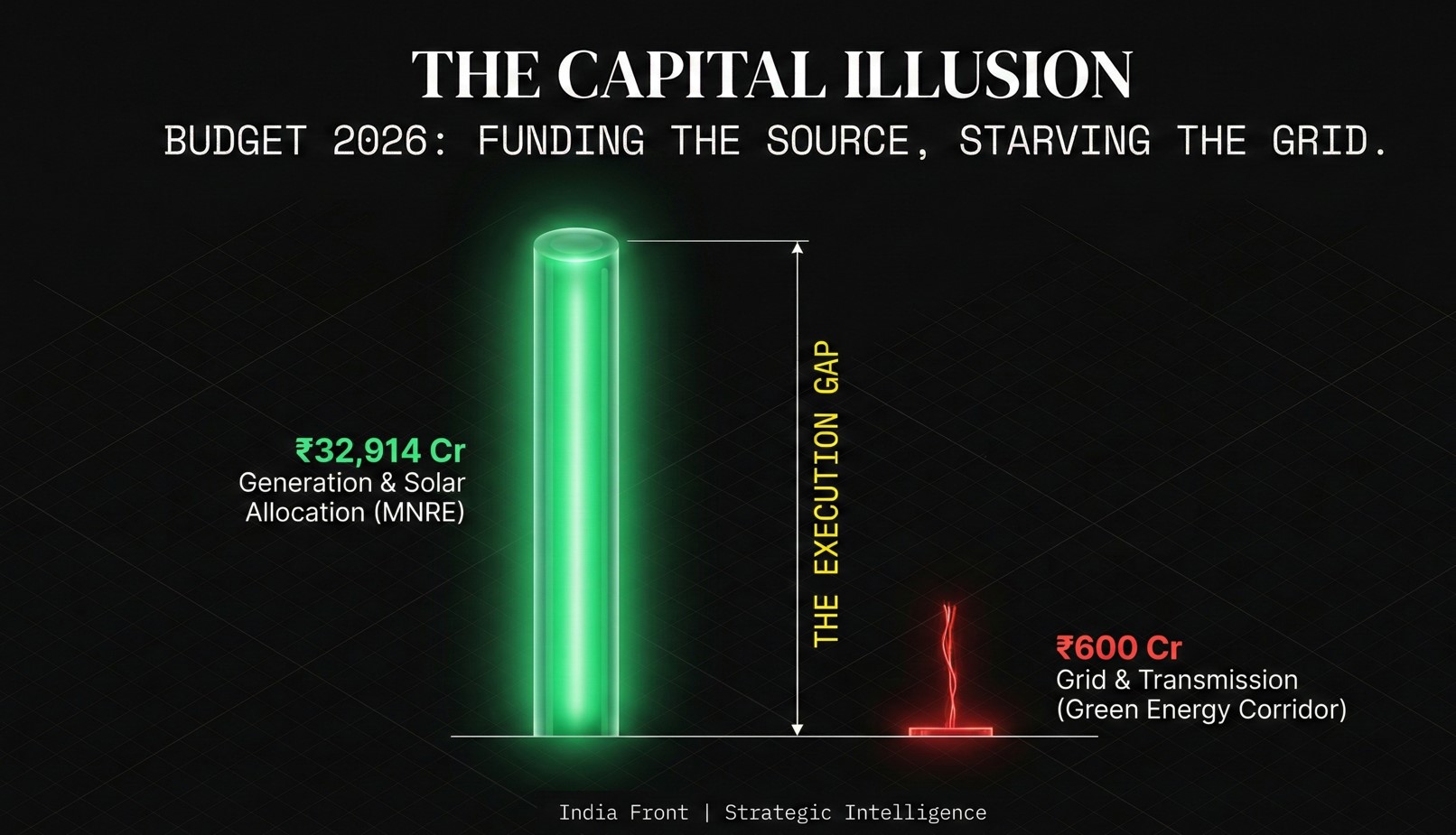
The Finance Minister has spoken, and the figures substantiate the India Front thesis that we are capital-rich yet infrastructure-constrained. The FY26-27 allocation of ₹32,914 crore to the Ministry of New and Renewable Energy signals a strong intent, reflecting a 24% increase from prior estimates. However, a detailed examination of this capital reveals a troubling imbalance, as the government has allocated ₹22,000 crore to PM Surya Ghar, which effectively guarantees a surge in solar panel installations on household rooftops, yet it addresses only the supply side of the equation.
The critical infrastructure required to evacuate this power—the high-voltage transmission lines and robust grid connectivity—receives a pittance by comparison. The Green Energy Corridor, which is the arterial system needed to carry clean power from source to consumer, is allocated a mere ₹600 crore. This budget allocates a Maserati to rooftops but provides a bullock cart for the highway. We are funding generation at a level that will inevitably overwhelm a grid that we are leaving to rust and suffer. It's a classic case of the left hand not knowing what the right is doing.
Strategic Verdict
We agree with the government's direction on sovereignty, but we strongly disagree on grid velocity. For domestic solar glass manufacturers, the removal of basic customs duty on sodium antimonate is a strategic move that directly protects our supply chain from Chinese price shocks. However, the flat allocation of ₹600 crore for the National Green Hydrogen Mission is not just a gamble but a potential strategic abdication that ignores the brutal physics of global capital flow. By committing only fractionally to the ecosystem that will power the vehicles, ships, and refineries of the 2030s, the budget fails to send the market signals required to attract the kind of multi-billion-dollar investments flowing into the US and EU.
The Execution Roadmap
To turn this budget into a Green Wave Blueprint, the industry must move beyond the ₹1,000 crore Viability Gap Funding for Battery Energy Storage Systems and view it merely as a pilot rather than a solution. The real roadmap requires a shift from project finance to ecosystem finance, where the first phase creates saturation of rooftop solar via the ₹22,000 crore Surya Ghar injection. The second phase will see the inevitable grid bottleneck emerge as supply outpaces evacuation. This is where the government's allocation falls dangerously short, and private capital will need to fill the ₹50,000 crore gap in transmission infrastructure to prevent the stranded asset crisis the sector currently faces.
The Unified Execution Command
We cannot wait for the Ministry of Power to lay every cable because the budget has defined the playing field, and now the actors must execute. The government must shift its role today from funder to debottlenecker by stopping the focus on targets and focusing entirely on the right of way. We need a National Transmission Override to slash the time required to erect high-voltage corridors from 36 months to 12. Infrastructure majors must realise they are no longer just EPC contractors but sovereign capacity builders. The institutional investor community must see that the risk is not in clean energy itself, but in the plumbing that connects it. That is where the alpha lies.
Mitigation Strategy: Co-Location and Common Carriers
We must immediately pivot from a subsidy-based mindset to a demand security framework to mitigate the risk of capital flight. Since the government will not provide the capex, it must ensure market availability by enforcing strict green hydrogen consumption obligations for state-owned refineries and fertiliser plants. The most practical mitigation for the transmission deficit is a ruthless focus on industrial co-location, where we build the factories next to the renewable energy source, bypassing the grid entirely. This isn't a workaround; it's a competitive strategy that has already made Gujarat a magnet for green industries.
Solutions Spotlight
The fix lies in targeted capital efficiency, where the industry stops celebrating generation incentives and demands transmission velocity. The capital must flow directly into the nodes of resistance, which are high-voltage transmission corridors and industrial-scale battery storage. We must treat the grid not as a utility but as a national security asset, where we prioritise the unglamorous plumbing of the energy sector over the optics of new capacity.
Strategy Note
For the energy CEO, the directive is internal resilience, where you do not build your business model on the assumption of perpetual subsidies. You must build it on operational excellence and secure your supply chain against geopolitical shocks. The winners of 2026 will be those who can execute projects with zero-defect speed while the competition waits for regulatory clarity.
Key Takeaway
Budget 2026 has successfully funded the hardware of the Green Wave, including solar panels and batteries, but has left the software of grid integration and transmission exposed. The India Edge will now depend on how quickly the private sector can build the storage and transmission assets that the state has underfunded.
Rishi Vora
Founder and Editor, India Front