
Budget 2026: The Industrial Nerve Centre
The government has funded the factory shell. Now, the industry must engineer the machine heart that beats inside it.
The expansion of the PLI corpus is the strategic centrepiece of Budget 2026. This ₹18,000 crore is a defining moment because it formally recognises High-Tech Manufacturing not just as a sector, but as India's industrial nerve centre. For five years, the focus has been on establishing the "Make in India" footprint. The government has now effectively cleared the capital hurdles and secured our seat at the high table of global electronics. However, capital buys capacity; it does not guarantee competitiveness. Inviting factories to operate on Indian soil is the opening chapter. Engineering the components inside those factories is the story we must write now.
The Value Equation
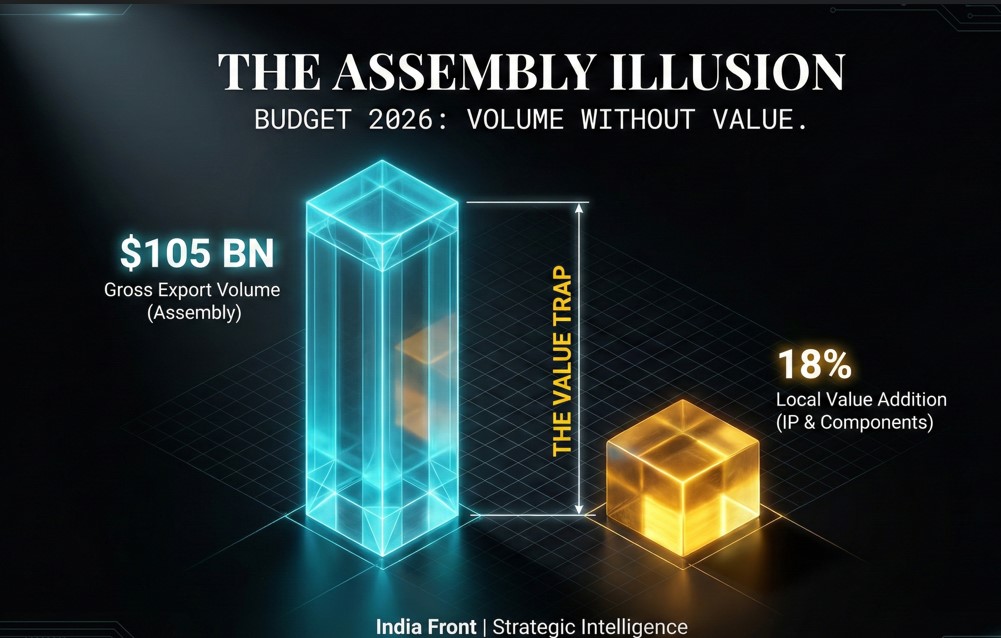
We must calibrate the quality of our growth. The balance between volume and value is the defining metric for this financial year. Lowering duties on precision machinery provides a tactical opening and lowers the entry barrier for advanced factories. However, using this merely to assemble more units would be a missed opportunity. The PLI scheme is best viewed not as a production subsidy but as an innovation war chest for High-Tech Manufacturing. The current model, prioritising gross production value, runs the risk of creating volume without value. Moving from assembly-only operations to component manufacturing represents a fundamental shift in the economic centre of gravity.
Targeting Tier-2 Precision
How do we convert this budget from a fiscal headline into an industrial reality? We pivot decisively from Tier-1 assembly to Tier-2 precision. The strategic focus shifts from the finished product to the Bill of Materials. Resources saved from the duty cuts on machinery should be directed toward acquiring foreign IP and retrofitting factories for sub-assembly fabrication. This is key to long-term competitiveness. Integrating Industry 4.0 standards is the mechanism to meet the zero-defect manufacturing requirement, which is no longer optional but a market entry requirement. The goal is to create a value map that demonstrates India's ability to manufacture the components, not just host the factories.
Evolving the Industrial Role
The strategic initiative has shifted from the policymaker to the industrialist. The industrial giants now have the opportunity to evolve from hosts for foreign brands to Engineering Guarantors. The joint venture model is moving beyond the simple arbitrage of land and labour. The new imperative is to integrate technology transfer clauses into contracts. The metric of success expands from factory square footage to the density of patent filings. For the MSME sector, the new credit guarantee of ₹5,000 crore is not simply working capital; it is an R&D entry ticket that allows smaller players to invest in upgrading their tool rooms to produce precision components, moving up the value chain from basic parts suppliers.
Securing Future Competitiveness
To avoid the Middle-Income Trap, we must establish a strong R&D foundation. We need not wait for government labs to invent the future. The private sector can view fundamental research as a strategic reinvestment, directing a percentage of PLI profits back into domestic labs. We also need a practical approach to the skills gap. A Factory-Academy Fusion, where specialised technical institutes are located directly inside industrial corridors, is the solution. The curriculum should align with individual factory requirements, creating a continuous pipeline of precision engineers rather than general graduates seeking jobs.
Solutions Spotlight
The path forward focuses on quality. Success will be measured by the percentage of the component value sourced from Indian soil. Capital flows should be directed toward the supply chain's core—the manufacturers of precision dyes and micro-components. Treating the component manufacturer as a primary strategic asset elevates the entire ecosystem and reduces dependency on complex global logistics.
Prioritising the Bill of Materials
The path forward focuses on quality. Success will be measured by the percentage of the component value sourced from Indian soil. Capital flows should be directed toward the supply chain's core—the manufacturers of precision dyes and micro-components. Treating the component manufacturer as a primary strategic asset elevates the entire ecosystem and reduces dependency on complex global logistics.
Owning the Recipe
For the manufacturing leadership, the directive is strategic vertical integration. A robust business model creates its own component resilience. It does not rely solely on external shipping lanes. The market leaders of 2026 will be those who control the entire production recipe, not just the final assembly.
Key Takeaway
Budget 2026 has successfully funded the factory shell. The responsibility now rests with the industry to engineer the machine heart. The India Edge depends on the speed at which we establish High-Tech Manufacturing as the true industrial nerve centre of the new economy.
Rishi Vora
Founder and Editor, India Front