
Budget 2026: Designing the High-Velocity Nervous System
₹12.2 lakh crore infrastructure engine. Industrial Corridors are the backbone of the $10 trillion economy.
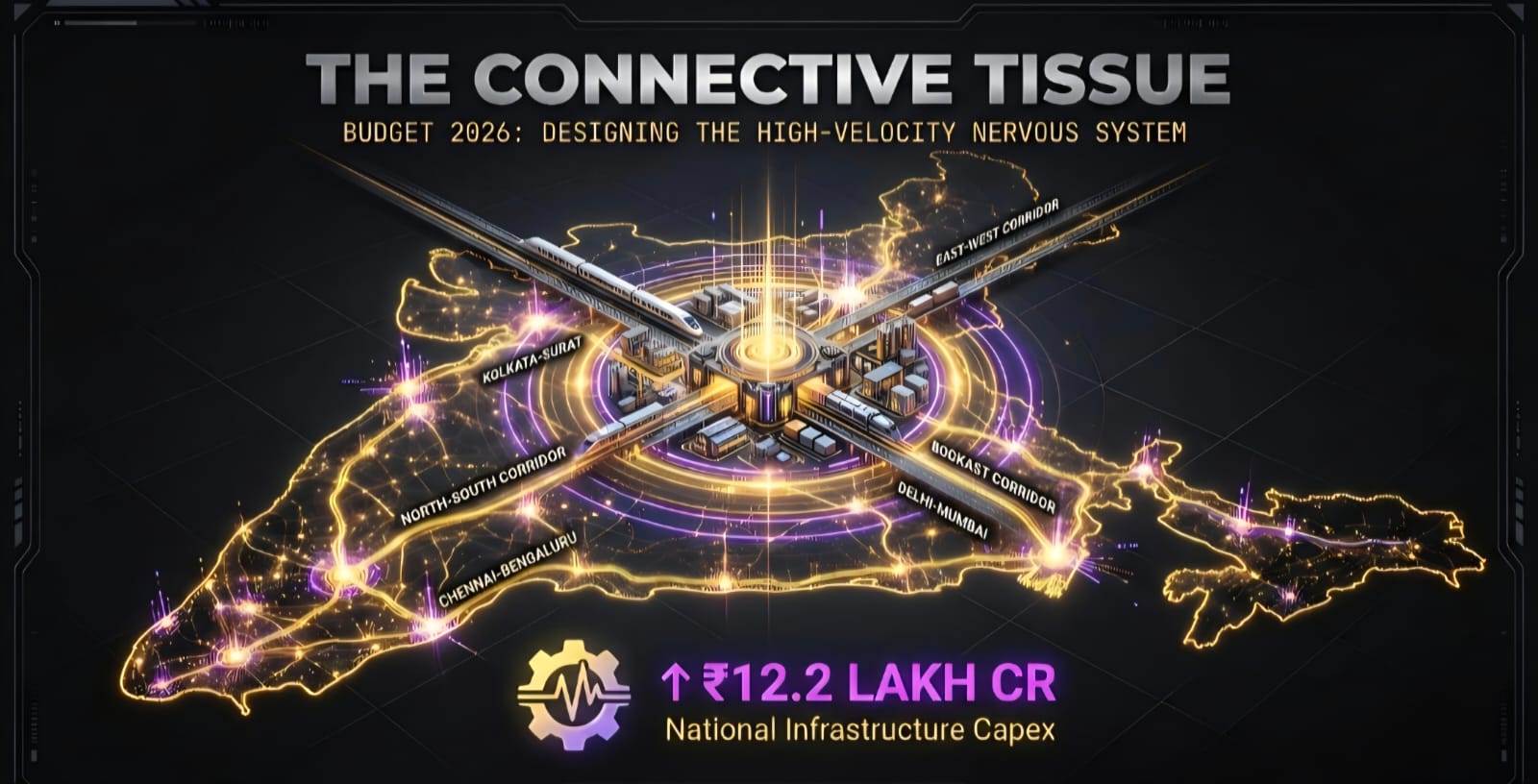
Industrial Corridors have moved beyond the realm of simple logistics paths; they have become the primary framework for India's manufacturing future. Budget 2026 reinforces this by deploying a massive ₹12.2 lakh crore infrastructure engine. We see a significant portion of this capital directed towards the National Industrial Corridor Development Programme (NICDP), which is now shifting its focus from port-centric development to deep hinterland integration. The centrepiece of this strategy is the prioritisation of six hyper-critical corridors: Delhi-Mumbai, Chennai-Bengaluru, East-West, Bokast, North-South, and Kolkata-Surat. Each corridor is designed as a self-contained economic artery, integrating smart logistics nodes with high-speed rail connectivity.
Strategic Analysis: From Transit to Ecosystems
The expansion of these corridors marks a departure from incremental connectivity. By allocating ₹5,000 crore specifically for urban infrastructure in Tier-2 and Tier-3 cities along these routes, the government is attempting to create "City Economic Regions". This means that infrastructure is no longer an end in itself but a catalyst for self-sustaining growth centres. The strategic intent is to collapse the distance between production hubs and consumer clusters. Furthermore, the emphasis on high-speed rail integration within these corridors is crucial; this positions them not only as freight routes but also as accelerators for regional talent mobility.
Opportunities for Reform and Strategic Depth
While the capital injection is historic, the real test lies in the "Time-to-Value" metric. Priority must now shift to a Single Window for Space. Bundling land, power, and water clearances into a single approval is essential to prevent these corridors from becoming stranded assets due to local administrative delays. There is a profound opportunity to revitalise the legacy industrial base. By modernising 200 ageing manufacturing clusters through technology upgradation, the government can ensure that existing capacity is converted to export-grade output, rather than remaining trapped in low-value domestic cycles.
The 2026 Execution Blueprint
The blueprint for the coming fiscal year requires a ruthless focus on digital-first logistics. The execution must prioritise the integration of the Gati Shakti data layer with physical movement to ensure that a container never stops moving due to a paper trail. This begins with the operationalisation of three major Multi-Modal Logistics Parks (MMLPs) within 18 months to demonstrate a definitive proof-of-concept for the industry. Simultaneously, the state must establish Infrastructure Investment Trusts (InvITs) for these corridors to unlock private capital and reduce the burden on the public exchequer.
Solutions Spotlight
The fix lies in the operationalisation of a "Logistics Efficiency Credit" using a portion of the ₹1.1 lakh crore logistics allocation. Firms that meet specific turnaround time benchmarks within the new corridors should receive rebates on terminal charges. This incentivises speed and creates a culture of high-velocity movement across the national network.
Strategy Note
Our narrative must transition from "roads and bridges" to "economic arteries" as defined by this year's fiscal strategy. India Front views these corridors as the primary mechanism for domestic value addition. The winners of 2026 will be the firms that capitalise on the ₹12.2 lakh crore capex by co-locating their manufacturing bases within these clusters to bypass legacy transit bottlenecks.
Key Takeaway
Industrial Corridors are the backbone of the $10 trillion economy, and Budget 2026 provides the necessary financial skeleton. The India Edge depends on our ability to breathe life into these corridors through digital integration and ruthless execution. We are not just moving goods; we are accelerating the velocity of national productivity.
Rishi Vora
Founder and Editor, India Front