
Budget 2026: Frictionless Frontiers – Capitalising the Next-Gen Logistics Backbone
₹1.1 lakh crore for the Next-Gen Corridor Initiative. Building the high-speed nervous system of a global economic superpower.
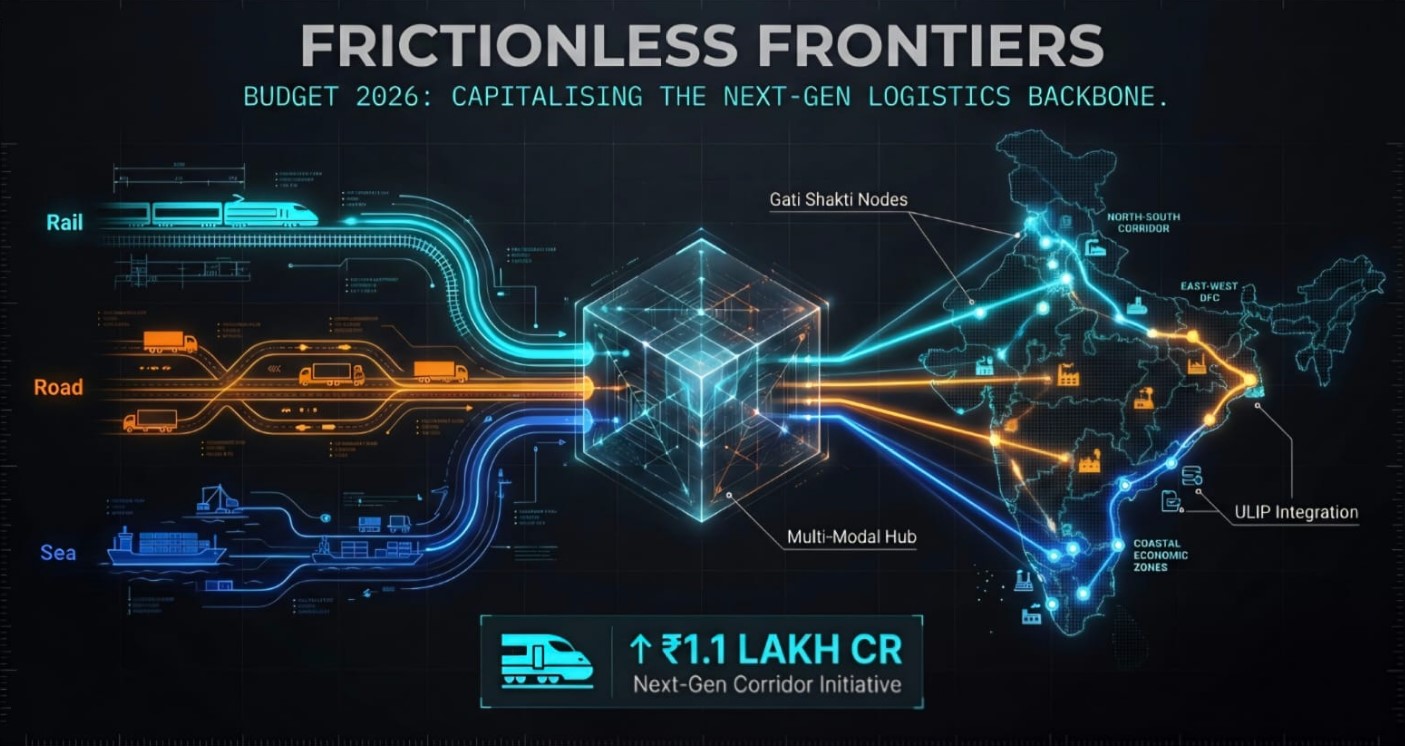
The government has doubled down on the PM Gati Shakti framework with a fresh allocation of ₹1.1 lakh crore for the "Next-Gen Corridor Initiative." Unlike previous years, the capital is specifically carved out for Multi-Modal Logistics Parks (MMLPs) and specialised industrial nodes in the East and South. A significant ₹12,000 crore has been earmarked for "Digital Logistics Architecture," aiming to integrate the Unified Logistics Interface Platform (ULIP) deeper into the private sector's operational DNA. The scope includes funding for container tracking, predictive analytics, and the elimination of paper-based documentation across all major ports.
The Strategic Opportunity
Efficiency is the only currency that matters in a global supply chain. We have spent decades with logistics costs hovering near 14% of GDP, a deadweight that makes Indian exports struggle against more agile neighbours. The opportunity now is to leverage this new capital to bring that number down to 8%. By funding the "Last Mile" connectivity to smaller industrial clusters, the budget is attempting to democratise manufacturing. We are no longer just connecting ports to metros; we are pulling the factory gates of Tier-3 cities onto the global shipping lane.
Strategic Verdict
We acknowledge the ambition, but the real test is the "Time-to-Value" metric. Pouring concrete is easy; synchronising a dozen different ministries to ensure a container moves from Nagpur to Mundra without a paper trail is the real challenge. The reduction in inter-state transit duties is a welcome reform. However, capital expenditure in logistics often suffers from a long gestation period. The industry cannot wait five years for these corridors to breathe. We need "Quick Wins"—perhaps the operationalisation of three or four MMLPs within the next 18 months—to demonstrate that the money is translating into movement.
The Execution Roadmap
Infrastructure is only as good as the data flowing through it. We need to stop viewing these corridors as mere transit routes and start treating them as data-rich economic ecosystems. The execution must prioritise the "Plug-and-Play" model for MSMEs. If a small-scale manufacturer has to spend six months getting a warehouse connection, the corridor has failed. The private sector should be incentivised to manage these nodes under a long-term lease model, bringing in their operational excellence to ensure the infrastructure doesn't just exist but thrives.
The Synergy Architecture
The Ministry of Railways and the Ministry of Road Transport must stop competing for the same freight. We need a unified command that optimises for the lowest carbon footprint and the highest speed, regardless of the medium. Simultaneously, state governments must align their land acquisition policies with the central vision. A corridor that stops at a state border due to a land dispute is a stranded asset. We need a "Single Window for Space," where land, power, and water clearances are bundled into one approval.
Solutions Spotlight
To accelerate the impact, the government should introduce a "Logistics Efficiency Credit" for exporters. Companies that utilise the new corridors and meet specific turnaround time benchmarks should receive a rebate on their terminal charges. Furthermore, we must invest in "Hydrogen-Ready" infrastructure along these routes. By setting up green fuelling stations at 200km intervals, we don't just move goods faster; we make the entire Indian supply chain the cleanest on the planet.
Key Takeaway
Budget 2026 has provided the skeleton for a new India. The India Edge depends on our ability to breathe life into these corridors through digital integration and ruthless execution. We aren't just building paths; we are building the high-speed nervous system of a global economic superpower.
Rishi Vora
Founder and Editor, India Front