
Budget 2026: The Orbital Economy – Beyond the Kármán Line
₹13,705.63 crore for the orbital economy. Space has matured beyond the laboratory into a strategic economic vertical.
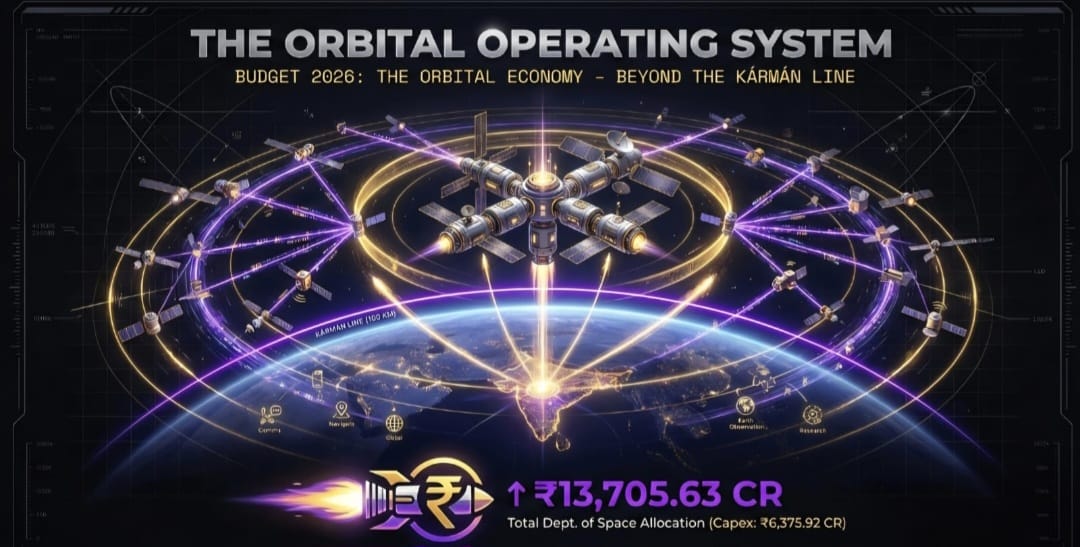
Space has matured far beyond the laboratory. Budget 2026 treats the vacuum as a strategic economic vertical, backed by a ₹13,705.63 crore allocation. This represents a 10.1% surge over the revised estimates of the previous fiscal. Crucially, capital expenditure has jumped to ₹6,375.92 crore, an increase of over ₹1,066 crore. These funds are strictly earmarked for hardware realisation. The focus has moved from ISRO-led discovery to the physical construction of next-generation launch pads and indigenous orbital infrastructure.
The Geopolitics of Proximity
Low-Earth Orbit (LEO) stands as the new front line of national power. Unlike geostationary belts, LEO sits just 200 to 2,000 kilometres above. Such proximity enables low-latency communications and high-resolution surveillance. It is the layer where hypersonic missiles are tracked and precision-strike data is processed in real-time. This close-range connectivity also fuels the global internet of things and remote sensing for agriculture. Consequently, ownership of the Low-Earth Orbit economy is no longer an abstract goal; it is an existential imperative. Budget 2026 capitalises this reality.
Opportunities for Reform and Downstream Depth
While the capital injection is significant, the private sector still awaits a direct fiscal space manufacturing package. Regulatory velocity must now match the capital spend. Priority must shift to a Direct-to-Satellite Spectrum Policy to integrate satellite broadband with domestic telecom rails. We see a clear opening for the liberalisation of high-resolution satellite imagery distribution. Indian start-ups must be empowered to build globally competitive GIS solutions without navigating foreign data bottlenecks.
The 2026 Space Blueprint
The roadmap for the coming fiscal year demands an ecosystem that survives beyond individual mission success. Hardware realisation is now the operational priority. Accelerating the operationalisation of the Kulasekarapattinam launch facility is essential to increase the national launch cadence and increase infrastructure scalability. Clearing the commercial queue will allow private players to meet global demand and establish a consistent orbital presence. Simultaneously, leveraging the Gaganyaan crewed module framework to seed the human spaceflight industry becomes a parallel track for long-term economic diversification.
Solutions Spotlight
Utilising a portion of the ₹6,375.92 crore capital outlay to underwrite "Commercial-First" launch windows for local start-ups is the next logical step. Establishing a flight-proven pedigree is the only way to secure the 8-10% share of the global space economy India targets by 2035.
Strategy Note
Our narrative must transition from celebrating ISRO's legacy to cementing India's commercial influence. India Front identifies this as a pivot from technology consumption to infrastructure provision. Success in 2026 belongs to the firms building the hardware "plumbing" of the orbital economy, capitalising on the 10.1% budget increase.
Key Takeaway
The Orbital Economy represents the new high-ground for national survival, and the ₹13,705.63 crore budget provides the financial propulsion. The India Edge depends on our ability to secure the assets that will define the next century of global trade.
Rishi Vora
Founder and Editor, India Front