
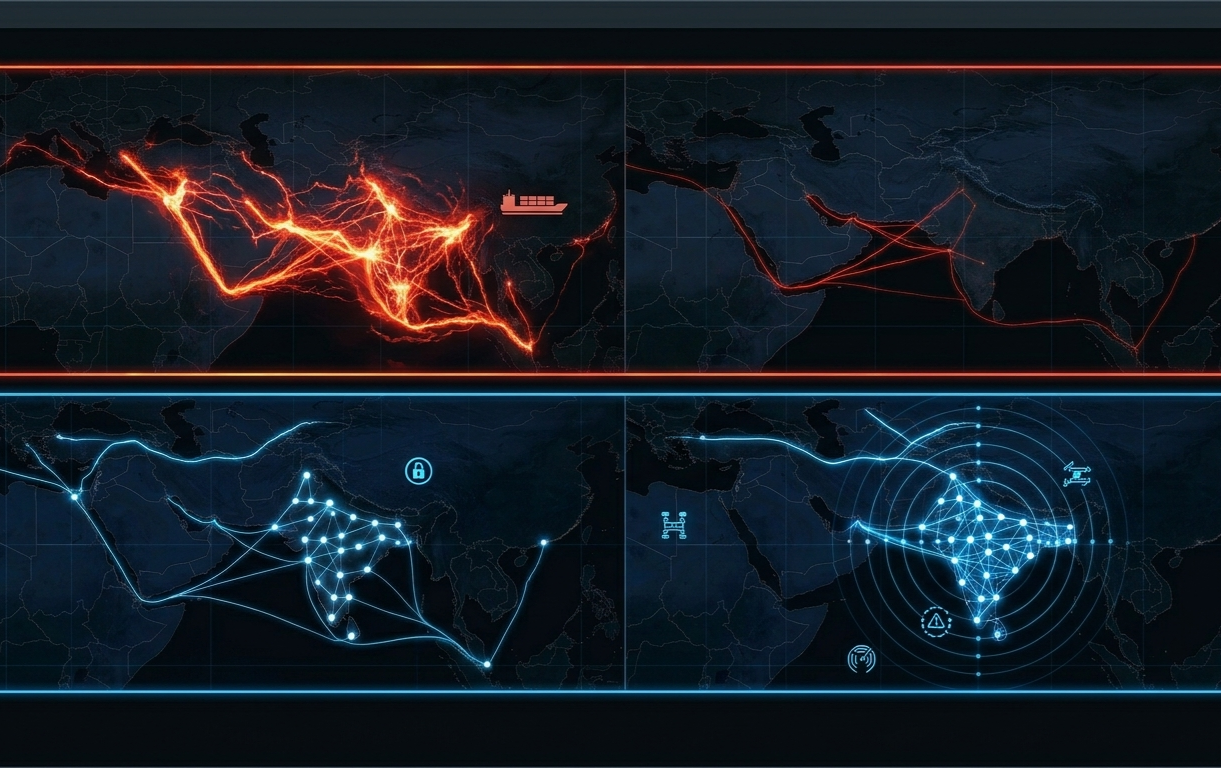
Top: the fragmented system before — chaotic routes, high variance. Bottom: the scale system after — India at the centre, stable architecture.
Issue 4 · Strategy Series
The Corridor Problem
A series on logistics, allocation, and India’s manufacturing future
Repeatability > Capability
Scale is not a function of growth; it is the replication of outcomes under variable conditions.
India does not lack the capability to succeed; it lacks the architecture to make that success inevitable.
Systems of scale begin where interpretation stops being variable.
Systems of Scale
How execution becomes replicable.
Part 4 mapped the failure: a cascade of reinterpretations that results in “Islands of Excellence.” This part defines the design of a system that preserves intent from the policy desk to the plant floor.
Scale is not a function of success events.
It is a function of outcome consistency.
It is produced by the systematic reduction of variance across the execution stack.
The Three Systems of Scale
To move from accidental success to repeatable scale, the execution stack must be re-engineered through three architectural layers.
1
The Standardization System
Lock Intent
The primary cause of failure is the re-interpretation of intent. Ambiguous policy is a signal that invites noise.
Fixed outcome definitions and non-negotiable output formats.
Moving from “Policy Ambiguity” to “Executable Instructions.”
Intent survives transit without mutation. The signal is locked at the source.
2
The Translation System
Bridge the Middle
India’s “Missing Middle” is the vacuum where intent is re-authored into local risk constraints. We need a dedicated layer that preserves signal fidelity.
Dedicated delivery units and program architects whose sole metric is intent-preservation.
Replacing “Bureaucratic Process Owners” with “System Execution Managers.”
Intent becomes executable without being re-priced at every administrative node.
3
The Feedback System
Compress the Loop
Signal decay happens in the dark. Without a real-time feedback loop, the system degrades faster than it learns.
Direct ground-to-design telemetry that bypasses interpretation layers.
Moving from “Activity Tracking” to “Outcome Verification.”
The system corrects for drift in days, not cycles.
The Variance Reduction Engine
Scale does not emerge from expansion; it emerges from predictability.
In a scale system, friction is not “overcome” by a hero — it is designed out of the architecture.
In an Island System
Execution depends on the temporary compression of friction by a leader.
In a Scale System
Execution depends on the elimination of the conditions that create friction.
When you reduce the variance of outcomes across nodes, the “Island” disappears because the “Mean” has been elevated.
The Repeatability Shift
India already has the inputs for scale. We have the capital, the talent, and the digital rails.
What we lack is the architecture that preserves these inputs across the interpretation stack.
Before
Intent → Interpretation → Distortion → Localized Anomaly.
After
Intent → Standardization → Translation → Feedback → Repeatable Outcome.
The Law of Fixed Intent
The more an instruction can be interpreted, the less it can be scaled.
The Law of Translation Fidelity
Scale is determined by the weakest link in the interpretation stack.
The Law of Variance Compression
Growth without repeatability is just a larger collection of failures.
Standardization is not Bureaucracy
Bureaucracy protects the process; standardization protects the outcome.
Middle-Layer Professionalization
The “Translation Layer” is the most valuable infrastructure India can build.
Automatic Correction
A system that requires a meeting to fix a known variance is a system designed for signal loss.
Until execution becomes repeatable, scale will remain accidental.
Scale is not driven by intent. It is engineered through execution design.
This series began with freight costs eroding PLI margins, traced where the contracts moved, showed what a missed window costs, named the re-interpretation stack that causes the failure, and now maps the architecture to close the gap. The corridor problem is solved at the system level, not the policy level.
The Corridor Problem — 5-Part Series
A series on logistics, allocation, and India’s manufacturing future
← Part 4
India and Systems of Scale
The execution gap that keeps India on islands
Series Complete
The Corridor Problem
5 parts · Issue 4 · India Front