
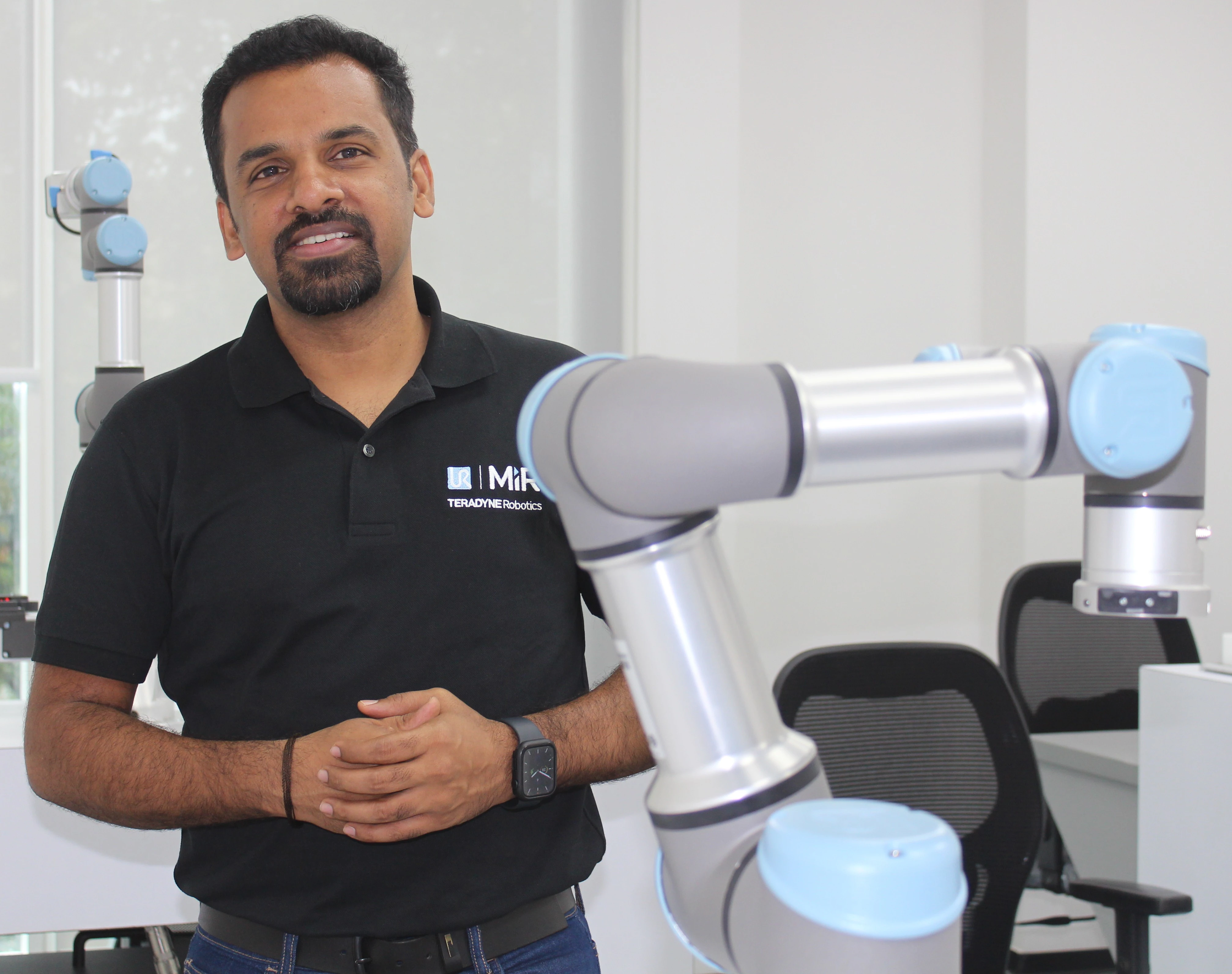
Sougandh KM
Business Director — South Asia, Teradyne Robotics
“Lifting a one-tonne sheet into a press is not a job. It is a task. It carries no intelligence. A job begins where judgement enters.”
— Sougandh KM
India runs at below 50 robots per 10,000 workers. Global leaders: close to 1,000.
AMRs now run 400 km per day inside factory systems, moving 200 kg loads.
Cobot payback period: 12 months—the MSME adoption ceiling.
India’s industrial ambition has a hard constraint. To reach a $10 trillion economy, manufacturing productivity must triple. The multiplier required for this mandate does not come from human muscle.
Sougandh KM, Business Director for South Asia at Teradyne Robotics, operates exactly in the middle of this deficit. He does not deploy; he corrects.
India runs below 50 robots per 10,000 workers. Global leaders run closer to 1,000. This gap is not statistical. It is structural.
For the economic grid to scale, the shop floor has to change form. Teradyne is not here to replace workers with robots. It is here to remove the physical ceiling on what workforce can do.
Task Illusion
The “automation paradox” assumes robots take jobs. Sougandh separates the problem differently.
Lifting a one-tonne sheet into a press is not a job. It is a task. It carries no intelligence. A job begins where judgement enters.
Indian factories are saturated with tasks. That is the drag. Automation doesn’t remove people. It pulls them out of repetition—the machine takes the load, the human takes control.
On a volatile supply chain, speed is bought, not negotiated. If a vendor can deliver 200 precision parts overnight, the order moves. Manual lines can’t hold that promise. Hybrid lines definitively can.
Capital Bypass
Most MSMEs don’t expand because they can’t cross the first cheque. Payback sits at twelve months. That becomes the ceiling.
When a cobot enters a process, variation drops. Rework drops with it. Scrap follows. The line holds. Meanwhile, the cost of labour climbs every year. Human precision degrades. The machine holds both.
That gap is where the system breaks—or upgrades.
OEMs aren’t waiting for balance sheets to catch up. They’re buying machines in blocks—hundreds, sometimes thousands—and placing them inside their own vendor networks.
The vendor doesn’t raise capital. The capability arrives first.
The OEM locks its supply chain. The MSME wakes up running a different factory.
High-Mix Architecture
India doesn’t run uniform volume. It runs variation—high-mix, low-volume, constant change.
Fixed automation fails here. So do large, caged lines built for repetition. What works is mobility.
A cobot runs one machine in the morning, shifts to welding by afternoon. Same unit. Different job. No rebuild.
That flexibility is the difference between two shifts and three. Output rises. The human load doesn’t.
Cluster Protocol
Policy still leans on incentives—tax breaks, subsidies. That doesn’t build adoption. It delays it.
Factories in a cluster don’t face different problems. They face the same one, repeatedly. Solve it once.
Test, deploy, replicate.
A shared application centre inside a cluster removes the guesswork. One integration becomes twenty. What used to take years compresses into weeks. The baseline doesn’t move factory by factory. It moves together.
The Physical Reality
This shift is not abstract.
AMRs now run 400 kilometres a day inside factory systems, moving 200-kilogram loads. That work didn’t disappear. It moved. Earlier, it sat on people. Now it doesn’t have to.
In Pune, a woman running a dual-CNC setup through a cobot didn’t come from robotics. She came from the line. The machine carries the third shift. She runs the system.
That change is not cosmetic. It decides who enters the workforce—and who stays out.
The Deployment Doctrine
Manufacturing scale does not follow headcount. It follows machine support.
Tasks are not jobs. Strip them out.
Density sets speed. Without it, output stalls.
Put machines into the supply chain, not just the balance sheet.
Solve adoption at the cluster level, or don’t solve it at all.
Protect the body. You expand the workforce.