
Mastery Manifest: Instituting Bharat Synchronous Cadence
Anchoring the 118 GW pulse to deliver unshakeable industrial certainty.
India’s ambition to become a global industrial hub depends on the absolute reliability of its power grid. Establishing a world-class manufacturing base requires more than just adding generation capacity; it demands the world’s most sophisticated energy synchronisation. The structural challenge lies in the inter-regional transfer capacity, which must scale to 118 gigawatts to ensure the seamless flow of power across state lines. For a premium economy, a fluctuating frequency is an unacceptable industrial risk. To build the “Sovereign Grid”, engineers have to transform the unpredictable nature of solar and wind into a steady, high-precision pulse. Success ensures that Indian factories, data centres, and green hydrogen hubs operate with 24/7 certainty, regardless of whether the sun is shining or the wind is blowing.
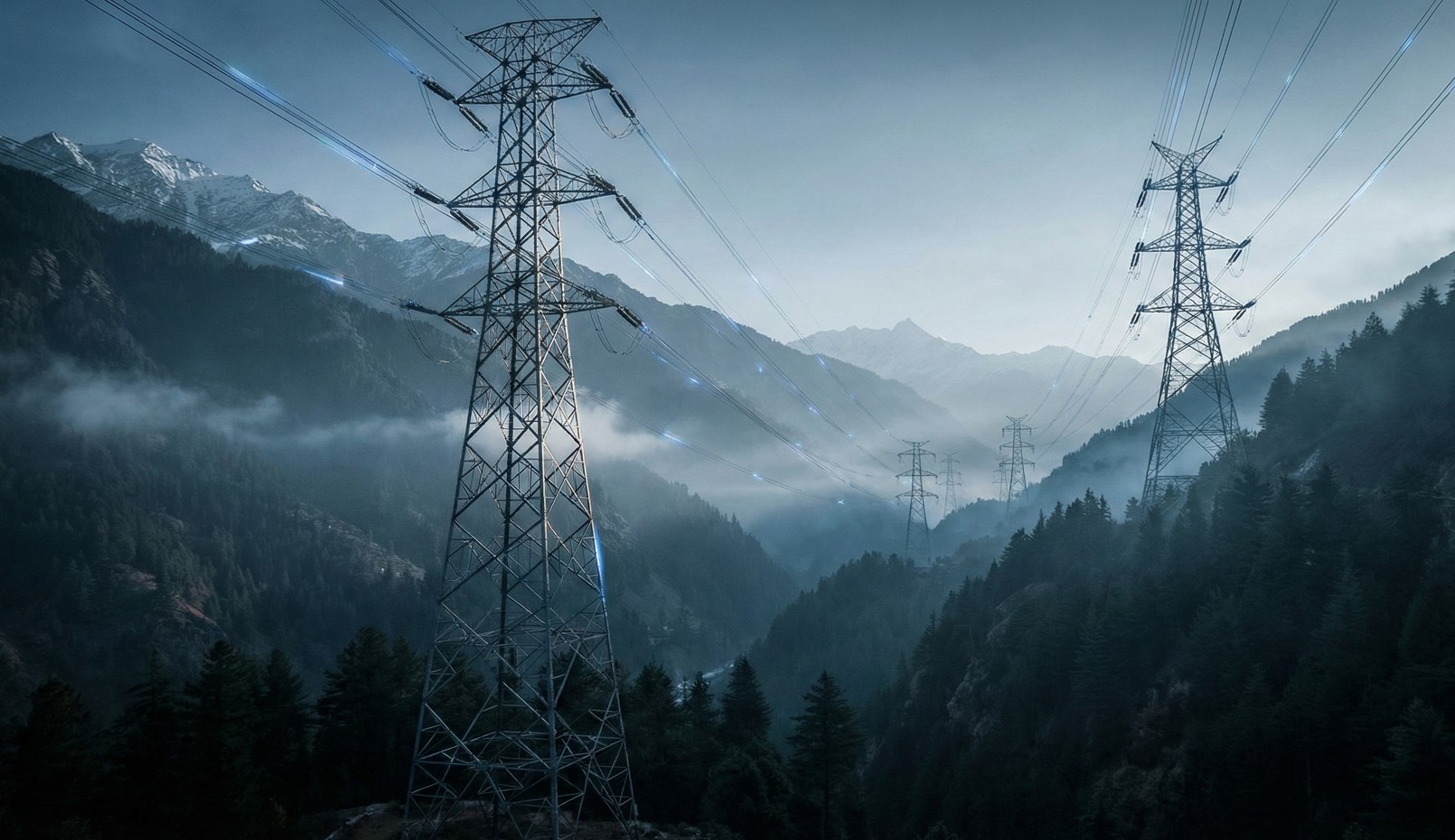
Stability in the face of the “Green Wave” relies on the massive expansion of the Green Energy Corridor (GEC). Phase II of the Inter-State Transmission System (ISTS) is currently architecting the evacuation of 13 gigawatts of renewable power from high-resource zones like Ladakh to the national heartland. Budget 2026 has accelerated this momentum, allocating ₹5.99 billion specifically for these corridors to ensure that infrastructure stays ahead of generation. Reaching national goals necessitates the installation of 4.5 lakh circuit kilometres (ckm) of new transmission lines. Building a physical circulation system allows the nation to move massive blocks of energy across thousands of kilometres with minimal loss, effectively making the entire country a single synchronous energy zone.
The Digital Nervous System
Managing a grid with massive renewable penetration requires a shift from manual oversight to automated, AI-driven command. The Power Grid Corporation of India (POWERGRID) has operationalised 13 renewable energy management centres (REMCs) to serve as the brains of the national grid. These centres use advanced weather forecasting and machine learning algorithms to predict renewable generation with high accuracy. Real-time data allows operators to balance the load every few minutes, preventing the frequency deviations that cause industrial outages. The Automatic Generation Control (AGC) system sends signals to power plants every four seconds to keep the frequency band at 50 Hz. Precision of this calibre ensures that the national grid remains resilient, even as the share of intermittent renewables crosses critical thresholds.
The deployment of “smart grid” technologies at the distribution level further secures industrial certainty. Predictive maintenance, powered by real-time sensors and AI analytics, identifies potential faults in substations before they manifest as failures. High-voltage substations are now being remotely operated, reducing human error and increasing response velocity. Establishing these digital safeguards allows India to absorb the variable energy of the “Green Wave” without compromising the quality of power delivered to the heavy industry. Successful digital synchronisation makes India the global benchmark for large-scale grid management, drawing investment from energy-intensive sectors that require absolute operational uptime.
The Global Interconnect
Sovereignty in the modern energy era extends beyond national borders through the “One Sun One World One Grid” (OSOWOG) mandate. This vision seeks to interconnect green grids across time zones, effectively ensuring that the sun never sets on the Indian energy supply. Interconnecting with the Middle East and Southeast Asia allows India to export surplus solar power during the day and import renewable energy from regions where it is still daylight. Developing these high-voltage direct current (HVDC) subsea links transforms India from a regional power consumer into a global energy orchestrator. Leadership in OSOWOG provides a strategic fail-safe against local weather variations, using global geography to guarantee national energy security.
By 2030, projections indicate a $1 trillion investment potential for this global grid, establishing India as the primary hub of a multi-continental energy highway. Success in this area requires the codification of international technical standards and regulatory frameworks to ensure seamless energy trade. By leading the Green Grids Initiative, India is not just sharing power; it is exporting its grid management expertise. By controlling these global flows of electrons, the Indian Green Wave stays a permanent, stable, and self-reinforcing event.
The Stabilisation Blueprint
Achieving 24/7 industrial certainty necessitates a ruthless focus on four technical pillars. First, the full operationalisation of the Green Energy Corridor Phase II ensures that renewable power from remote zones reaches industrial clusters in the south and west. Second, the giga-scale deployment of Battery Energy Storage Systems (BESS) and Pumped Hydro Storage (PHS) provides the necessary buffer for a system under transition. The ‘Duck Curve’ is no longer a theoretical risk; it is an active engineering bottleneck. To prevent grid instability during the evening ramp, the Sovereign Grid is deploying giga-scale storage to bridge the solar sunset. Third, the nationwide rollout of smart meters and demand-side management tools allows the grid to adapt to consumption patterns in real time. Finally, the expansion of the OSOWOG undersea cables integrates the national grid into the global solar loop.
The roadmap to 2035 is about moving from a reactive system to an anticipatory one. India uses its advanced transmission architecture and AI-powered command centres to deliver power at a level previously unimaginable for a developing country. Autonomy over the grid’s pulse is the ultimate competitive advantage. Early movers in grid modernisation possess the reliability standards and industrial loyalty of the world’s largest companies. Architecting the Sovereign Grid ensures that the “Green Wave” remains a steady, unshakeable force of national progress. The frequency is stable. The synchronisation is perfect. The power is certain.
Solutions Spotlight
The Synchronous Cadence Blueprint: Five Actions
- • Accelerate GEC Phase II to evacuate 13 GW from high-resource zones including Ladakh, ensuring transmission infrastructure leads generation capacity
- • Operationalise giga-scale BESS and Pumped Hydro Storage to neutralise the Duck Curve and provide 24/7 industrial certainty
- • Expand POWERGRID’s 13 REMCs with next-generation AI forecasting to achieve sub-minute grid balancing at 118 GW inter-regional transfer capacity
- • Nationwide smart meter rollout with demand-side management integration to enable real-time grid adaptation to industrial consumption patterns
- • Advance OSOWOG HVDC subsea links to Middle East and Southeast Asia, transforming India into the primary hub of the global solar grid
Key Takeaways
- • The 118 GW inter-regional transfer capacity target is not an aspiration—it is the engineering mandate for India’s industrial certainty
- • POWERGRID’s 13 REMCs with AGC signals every 4 seconds are India’s digital grid brain—the most sophisticated renewable management architecture in the world
- • The Duck Curve is no longer theoretical—giga-scale BESS and PHS are the active engineering solution for the solar sunset bottleneck
- • OSOWOG’s $1 trillion investment potential transforms India from a power consumer to a global energy orchestrator and standards-setter
- • Grid reliability is the primary industrial investment signal—24/7 certainty at Indian cost curves draws energy-intensive global manufacturing
Strategy Note
The frequency is the factory’s most critical input. Every 0.1 Hz deviation in the national grid costs Indian heavy industry in downtime, quality failures, and lost investment signals. The Sovereign Grid is not infrastructure spending—it is the competitive moat that makes India the only emerging market that can credibly offer global-standard industrial power at emerging-market cost.