
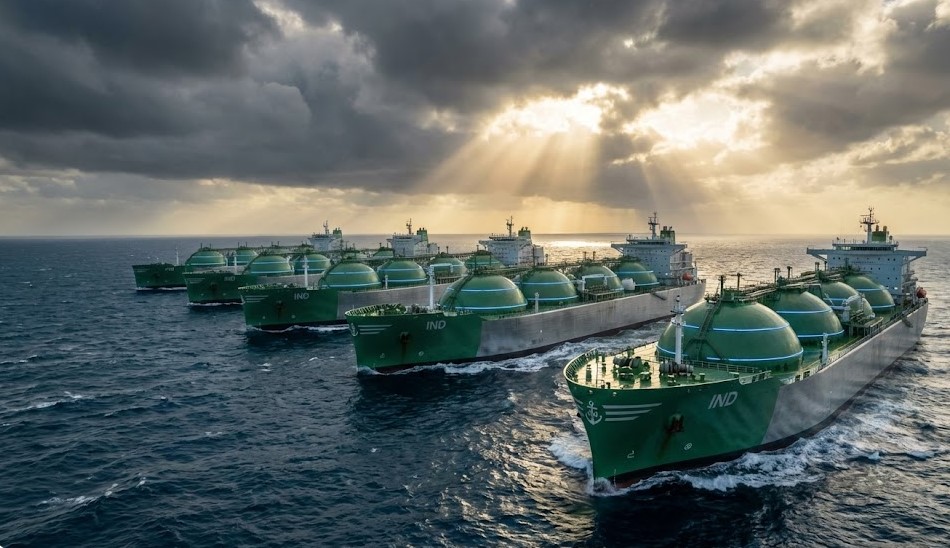
The Molecule Moat: Codifying Global Trade Sovereignty
How India is engineering the South-South shield to dismantle the Global North's monopoly.
India’s emergence as the primary architect of the green hydrogen economy signals a definitive shift in global industrial leadership. Scaling toward a 5 million metric tonne production target by 2030 positions the nation as the central engine of a sovereign energy order. Strategic dominance in the molecule economy facilitates the creation of a high-value trade ecosystem designed to secure the industrial future of the Global South. Consolidating the collective industrial power of emerging nations creates a sovereign economic bloc capable of defining global market terms. Robust South-South collaboration represents the definitive roadmap to ensuring stability and growth across every emerging market involved in the transition.
Ambition dictates that India engineers the foundation of the new energy order to ensure a central role in the global hierarchy. By 2030, the National Green Hydrogen Mission aims to establish a world-leading production capacity, supported by a ₹19,744 crore initial outlay. Capturing 10 per cent of the global trade in green derivatives supersedes the initial goal of domestic self-sufficiency. Volume alone represents a vulnerable metric in a volatile market. To avoid the legacy trap of “green extractivism,” where countries only export raw molecules and high-value technology stays in the West, strategic success needs a unified trade bloc. Leadership involves pivoting the narrative from simple production to global price sovereignty.
The Reciprocity Doctrine
Energy sovereignty depends on the rapid deployment of a unified, rules-based architecture. Established economies cannot be allowed to maintain asymmetric regulatory dominance over a market where the Global South provides the primary fuel. Sanjeev Sanyal, a member of the Prime Minister’s Economic Advisory Council, provides the psychological anchor for this shift. He notes that the global order does not yield to those who ask. His philosophy of “Duniya jhukti hai, jhukaney wala chahiye” defines the current approach to green trade. India no longer seeks permission to enter markets; instead, the nation leverages its massive domestic scale to demand reciprocal tariff cuts. Strategic growth involves shifting from energy replacement to energy addition. Union Minister Hardeep Singh Puri emphasises that success involves adding indigenous molecular engineering to the global balance sheet rather than replacing oil with imported hardware.
Staggering numbers support the current trajectory. To reach the global net-zero target, the world requires an estimated $10 trillion in green hydrogen investments by 2050. The investment gap currently represents the primary hurdle to large-scale adoption. High capital costs and uncertain demand signals keep the majority of projects at the pilot stage. Breaking this stalemate involves leveraging the G20-led initiative on the Global Biofuels Alliance as a template for a Global Hydrogen Alliance. The blueprint for a South-South trade corridor pairs India’s engineering velocity with the resource wealth of the African and Latin American heartlands.
Neutralising the Mineral Hegemony
The hardware of the green wave is anchored in a violently uneven distribution of critical minerals. High-precision chemistry within the electrolyser stack relies on a handful of elements currently held in near-monopolies. Reliance on single-source geography—where China controls over 60 per cent of rare earth elements and over 85 per cent of global refining capacity—presents a strategic vulnerability. India is spearheading a collaborative model to dismantle these bottlenecks through comparative industrial advantage. Under this framework, mineral-rich nations in the Global South are encouraged to pivot toward specialised component manufacturing rather than raw ore extraction. A nation providing nickel foam for alkaline electrolysers creates a symbiotic link with a high-precision manufacturing hub like India. Pooled investment derisks the entire supply chain and transforms a hardware dependency trap into a collaborative moat. Information transparency serves as the final weapon in this arsenal. Sharing trade data and co-developing indigenous intellectual property ensures the Global South remains a rules-maker in the new global energy order.
Market Readiness over Subsidy Reliance
The commercial floor for this trade is already under construction. Anil Chalamalasetty, founder of AM Green, has demonstrated that Indian green hydrogen is bankable today by meeting the rigorous European RFNBO standards. His 500,000-tonne annual green ammonia agreement with Uniper serves as the first high-volume proof of concept. Meeting international standards represents a strategic choice rather than a regulatory hurdle. Securing binding offtakes with the highest-paying markets allows India to establish a price floor for the entire region. Action of this scale prevents a race to the bottom where emerging markets undercut each other to secure small, non-bankable contracts. Movement from pilot projects toward binding global offtakes allows for financing based on internal commercial logic. Market readiness has superseded the era of subsidy-driven aspirations.
Hard data backs the current claims. The SECI tenders reveal a green ammonia price of ₹55.75 per kg, marking a definitive commercial watershed. Market-ready reality has replaced the era of subsidy-driven aspirations. Scaling this industry requires a unified financial architecture. The ambition involves securing ₹8 lakh crore in private investment by 2030. Reaching this target necessitates standardising medium-term offtake agreements. Without contract sanctity and pricing transparency, global capital will remain on the sidelines. India is building the financial rails—through Sovereign Green Bonds and Viability Gap Funding—to ensure that the molecule is as bankable as the electron.
The Standardisation Fortress
Structural hurdles hidden within the European Union’s Carbon Border Adjustment Mechanism (CBAM) require careful recognition. While framed as a climate tool, the mechanism functions as a sophisticated trade wall. The financial burden of climate mitigation shifts onto the producers in the Global South under this system. A failure to act as a unified bloc results in Indian industries paying the carbon tax while established economies reap the benefits of decarbonised fuels. The South-South Shield counters this approach with the Reciprocity Doctrine. If green molecules are suitable to power European factories, then green steel is suitable to enter those markets without a carbon penalty. Leverage of this scale allows India to act as the high-tech furnace of the Global South. Strategic positioning moves beyond selling hydrogen toward providing a pathway to industrial survival.
Architecting the Logistical Spine
The logistical reality of the molecule surge stops at the port and the pipeline. Moving the molecule requires dedicated infrastructure that the Global North currently hesitates to fund. The South-South Shield requires a dedicated financial architecture. Implementation includes mobilising sovereign green bonds and creating a unified investment fund for transboundary pipelines. Pushing beyond the 15 per cent metallurgical blending limit in existing gas grids is a mandatory goal. Dedicated hydrogen corridors connecting the industrial heartlands of the South to the global maritime hubs are essential. Success involves more than building pipes; it involves constructing the physical nervous system of the new global energy order.
Interoperability through strict standards forms the bedrock of this resistance. Open and transparent trade in decarbonised hydrogen remains non-negotiable. Deepak Yadav of CEEW argues that certification serves as the frontline. If established economies set the standard for “greenness”, they could implement a de facto tax that devalues Indian molecules at the border. The South-South Shield preempts such an action by establishing indigenous standards that reflect domestic manufacturing realities. A molecule validated in an Indian electrolyser carries unquestioned commercial weight globally.
Strategic success requires the execution of a ruthless industrial blueprint. The reciprocity lever remains the primary diplomatic weapon. Leveraging the National Green Hydrogen Mission’s 5 MMT production target allows India to demand immediate, zero-tariff access for finished green goods in Western markets. Parity is the baseline of trade. Standard sovereignty serves as the next defensive wall. Leadership involves the creation of a South-South Unified Carbon Protocol to bypass biased, Western-centric certification hurdles. India defines the rules of the arena rather than seeking permission to trade.
The industrial roadmap moves from price takers to market makers. India leverages production targets to demand tariff-free access, creates independent carbon protocols to secure standard sovereignty, and builds regional mineral corridors to dismantle monopolies. Standardising offtake agreements and operationalising strategic maritime export zones builds a defensive trading fortress. Discarding the “developing nation” label is a prerequisite for leadership in the green energy economy. Early movers own the sun, the wind, and increasingly, the manufacturing floor. Scale serves as the primary negotiating weapon. The molecule is the new currency. The trade bloc is the fortress. The world bends because we have made it so.
Solutions Spotlight
The South-South Shield: Five Pillars
- • Reciprocity Lever: Use the 5 MMT production target to demand zero-tariff access for finished green goods in EU and East Asian markets
- • Standard Sovereignty: Create a South-South Unified Carbon Protocol to bypass Western-centric certification hurdles and establish indigenous greenness standards
- • Mineral Shield: Establish regional manufacturing corridors with Brazil and the DRC to secure the electrolyser supply chain against single-source monopolies
- • Binding Offtakes: Standardise medium-term offtake agreements to attract the projected ₹8 lakh crore in mission-critical investments
- • Infrastructure Hubs: Transform maritime hubs at Kandla, Paradip, and Tuticorin into high-velocity export zones for green derivatives
Key Takeaways
- • India’s 5 MMT production target is not an environmental goal—it is the negotiating weight to demand reciprocal tariff cuts from the Global North
- • “Duniya jhukti hai, jhukaney wala chahiye”—the Reciprocity Doctrine defines India’s new posture in global green trade negotiations
- • Western certification standards for ‘greenness’ are the new trade barrier—the South-South Carbon Protocol is the preemptive shield
- • The $10 trillion investment gap by 2050 is the South-South opportunity: pair India’s engineering velocity with Africa’s resource wealth
- • Volume without price sovereignty is green extractivism—the molecule moat is built on standards, trade blocs, and binding offtake agreements
Strategy Note
The molecule moat is not built by producing the cheapest hydrogen. It is built by owning the standards, the certification protocols, the trade corridors, and the offtake agreements. India must transition from the world’s most efficient molecule producer to the world’s most dominant molecule trader. The difference is ₹8 lakh crore in protected investment.