
Global Dominance: THE $500 BILLION BLUEPRINT
From Service Giant to Product Sovereign. ICEA Chairman Pankaj Mohindroo decodes the definitive strategy to pivot India from a digital back-office to a hardware architect.
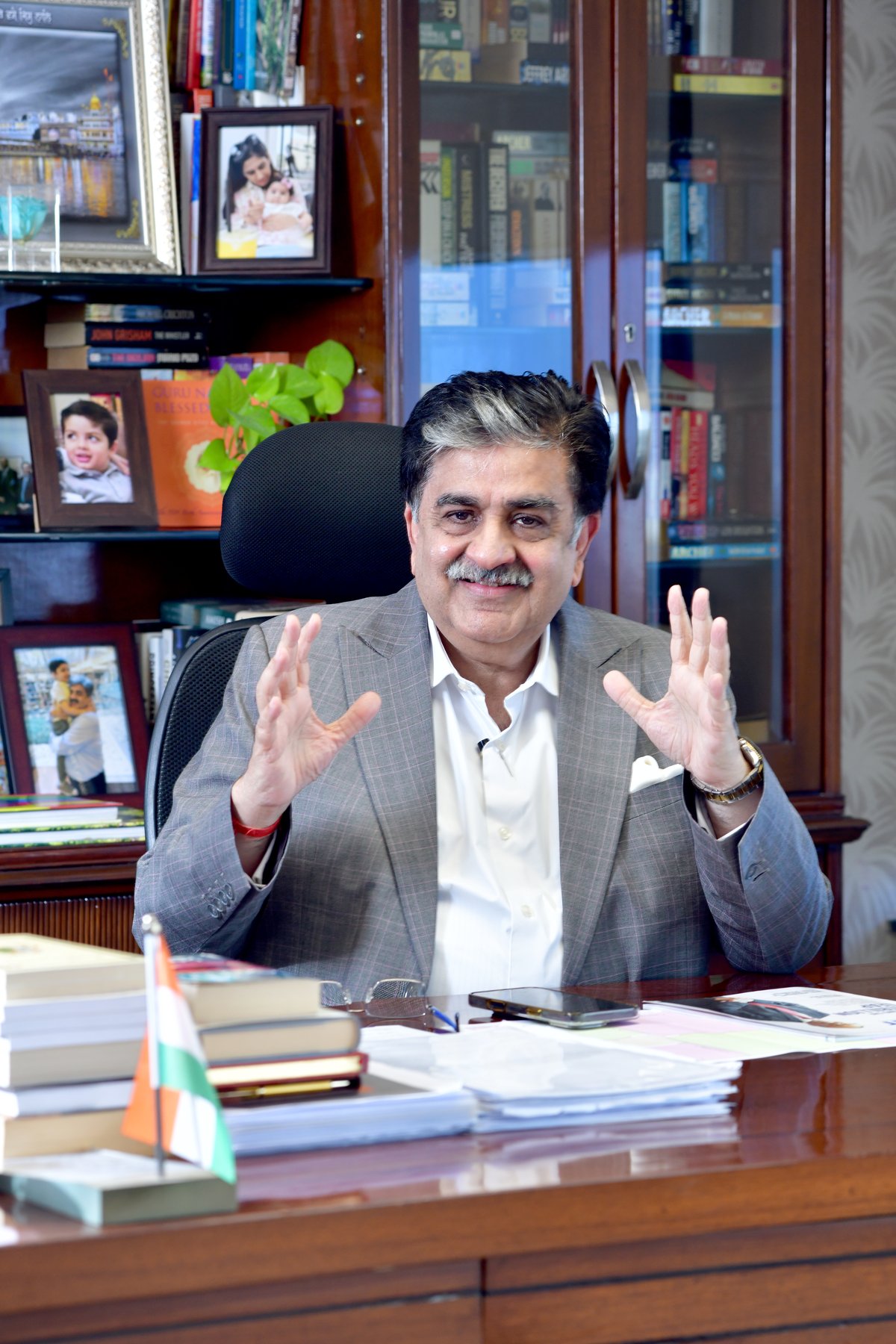
Pankaj Mohindroo
The silhouette of construction cranes rising over the arid plains of Dholera signifies more than infrastructure. It signals the definitive arrival of India's industrial resolve. For fourteen years, the nation's semiconductor ambitions matured through high-level policy debates. Today, as the first fabrication unit emerges, those theoretical frameworks have crystallised into physical reality.
But Dholera is not the destination. It is merely the launchpad. The government's vision extends far beyond erecting a factory; it is to build a legacy in the global value chain. The target is a staggering $500 billion in electronics production by 2031. Pankaj Mohindroo, Chairman of ICEA and the veteran architect of this ecosystem, argues that India is undergoing a definitive evolution. We are shifting focus from satisfying domestic demand to commanding global markets.
The physical emergence of the Fab in Dholera is a powerful visual. Does this moment feel like vindication for the ecosystem after fourteen years of policy oscillation, or is it just the beginning of the real marathon?
It is undoubtedly vindication. I have been deeply involved in this gruelling, long-gestational battle for nearly fifteen years. Bringing the stakeholders to a consensus was an intricate exercise in industrial diplomacy. Seeing the infrastructure rise at Dholera is the tangible proof that the India Semiconductor Mission (ISM) has graduated from PowerPoint to concrete. However, you are right to acknowledge that it is just the beginning. The execution phase is brutal. We are two years into the mission.
Addressing the Supply Glut Concern
There is a concern that our domestic consumption—projected around $110 billion—cannot entirely absorb the output of the Dholera fab. Are we risking a supply glut without formal purchase guarantees?
We must promptly address the arithmetic. The $110 billion figure is a consumption metric, which is irrelevant to our strategic goals. Our vision is production, not just consumption. The target is $500 billion in total output by 2031. Let me break down that number: $350 billion will come from final products, $75 billion from sub-assemblies, and a critical $75 billion from components—including $15 billion in pure semiconductors.
The domestic market provides a robust $80 billion foundation. However, to reach the $500 billion target, we must leverage this volume to achieve the global competitiveness required for exports. The market is not the Indian consumer buying a phone; the market is the global OEM embedding an Indian-designed, Indian-fabricated chip into their supply chain. If we rely solely on domestic absorption, the math fails. We are building for the world.
Competing with China
A major counterargument from sceptics is the Chinese price. Can Indian chips, even with PLI, compete with Chinese legacy nodes?
The narrative of cheap Chinese dumping is a dangerous fallacy we tell ourselves to feel superior. We must shed this complacency. China is not winning because of low prices; they are winning due to their competence. They are producing high-node chips with terrifying aggression, scale, and quality. It is a myth that their products are inferior. To compete, India cannot rely on tariffs alone. We are entering a hyper-competitive arena where Chinese incumbents are aggressive on price but also increasingly on quality.
The Node Distinction
Let's address the node distinction. While the public imagination often defaults to smartphone chips, the Dholera facility's focus is to power industrial electronics.
That is an accurate reading of the roadmap. We must decouple the public fascination with ultra-advanced smartphone chips from the industrial reality. The $50,000 wafers rolling out of Dholera are not intended for flagship handsets—that is not the immediate target. The real volume lies in the foundational layers: industrial electronics, automotive systems, and consumer durables like air conditioning. These sectors rely heavily on higher nodes. By securing this layer, we aren't just playing catch-up; we are building a foundation.
From Service Provider to Product Owner
How do we transition from an ecosystem of service providers to one of product owners who architect and hold the intellectual property?
I want to address the criticism often levelled at this phase of our evolution—what some cynically call being "Tech Coolies". I strongly reject that label. The service economy was a blessing, contributing to the establishment of our current capital reserves and talent pipeline. A coolie carries the load that makes the journey possible; that value is immense.
However, the pivot is now non-negotiable. We have mastered "design" for MNCs. The next step is architectural sovereignty—designing the product, owning the mask set, fabricating it locally, and finding the customer. That is the difference between a contractor and an industrial power. We are seeing major conglomerates like L&T entering the design space. Startups are entering the design space, but big capital is making a significant impact to bridge the gap from design to product.
Structural Disabilities
Beyond the PLI and government investments, Indian manufacturing still contends with structural disabilities.
We have solved the labour arbitrage; our demographic dividend is real. We have solved the power cost issue; we are now competitive with China. The remaining anchor is the cost of capital. An Indian manufacturer fights with one hand tied behind their back, paying 7.5% to 8.5% interest. A competitor in China or Vietnam pays 3% to 4%. This interest rate gap of nearly 5% is a lethal structural tax. You cannot build a capital-intensive ecosystem like semiconductors when your money costs almost double what your competitor pays.
The Next Immediate Priority
Looking at the ecosystem gaps, where is the next immediate fire that needs fighting?
The glare is on the Fab, but the void is in the Display sector. We do not have a single display fab. For a nation aiming to be a global electronics hub, this is a gaping hole. We would benefit from having two or three display fabs to complement the semiconductor units. That is the unfinished agenda of ISM 2.0.
The Final Mandate
Finally, if you had to distil the industry's request to the Government of India into a single mandate for the next decade, what would it be?
Trust us. When Arun Jaitley was finance minister, he asked me the same question. My answer remains unchanged. We are transforming a nation's historical view of the private sector with suspicion. The government must move from being a regulator to a partner. Build the pipelines of trust, and then be merciless on those who evade it. But do not choke the ecosystem with suspicion before it even learns to breathe.
Solutions Spotlight
- 1.The Financial Equaliser: The state must neutralise the 5% interest rate disadvantage against China and Vietnam to make capital-intensive fabs viable through aggressive interest subvention.
- 2.The Missing Link: Launch a dedicated incentive scheme to establish 2-3 Display Fabs, closing the critical gap in the electronics supply chain.
- 3.The Volume Play: Prioritise legacy nodes (28nm+) for industrial and automotive electronics, where volume and longevity outstrip the volatility of smartphone chips.
Strategy Note
- The Math of Export: Domestic demand is insufficient to sustain the mega-fabs; export is not a choice; it is an arithmetic necessity.
- Competence over Cost: China wins on yield and quality, not just subsidy. We must match their engineering rigour.
- The Capital Tax: Without aggressive interest subvention, the 5% cost-of-capital gap makes Indian manufacturing structurally uncompetitive.
Key Takeaways
Harmonise domestic consumption with global scale. The strategy is no longer "Import Substitution" versus "Export Growth"—it is both. By securing the $100 billion domestic market as a baseline and targeting the global value chain for scale, India activates two engines of growth simultaneously. This creates a manufacturing ecosystem that is resilient by design.