
Renewable Muscle. Global Dominion.
Deployment was the warm-up; ownership is the real game. Subrahmanyam Pulipaka reveals the ₹33 Lakh Crore roadmap to move India from the sidelines to the captain's chair. Every rupee of this industrial overhaul fuels the Indian Century.
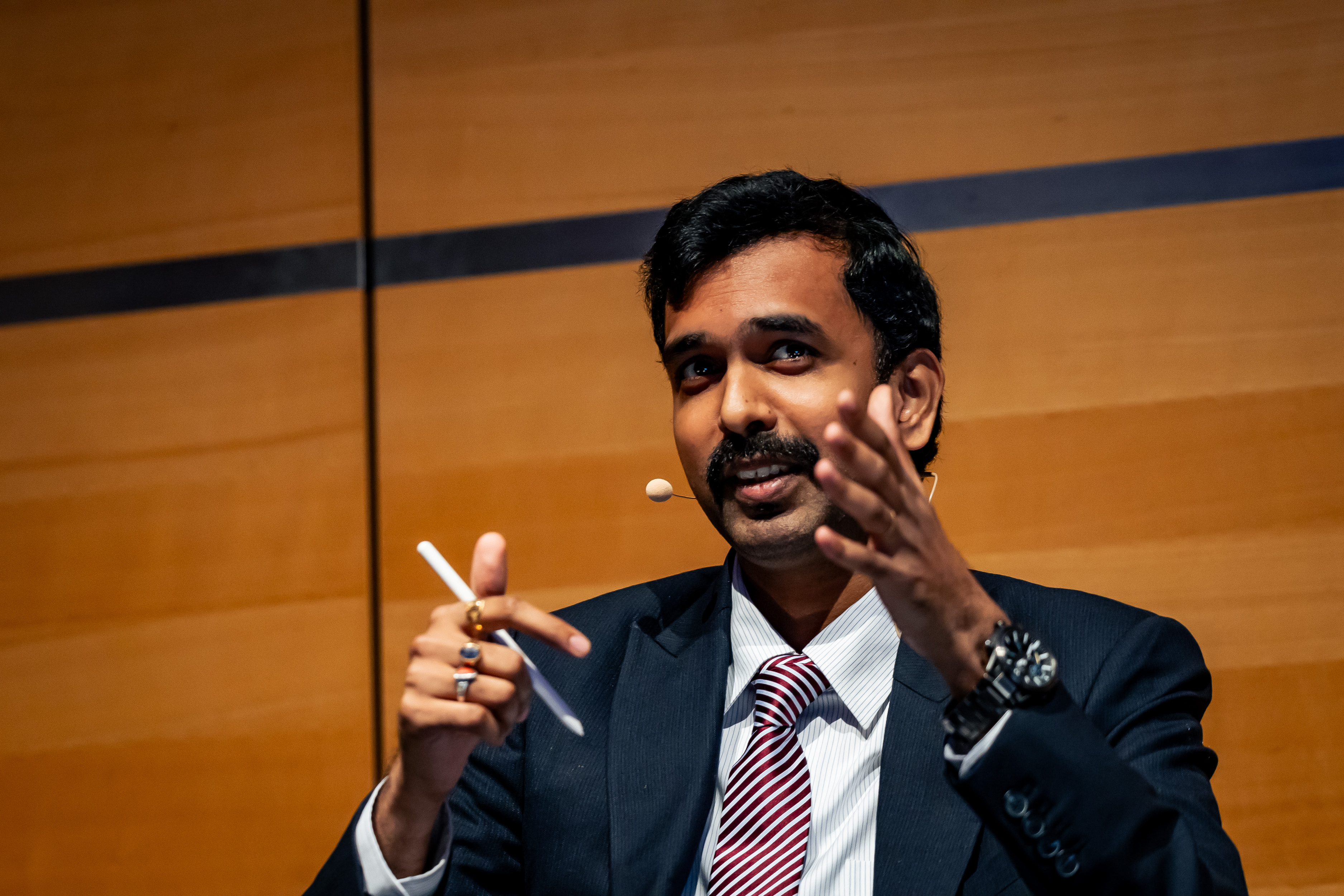
Subrahmanyam Pulipaka
CEO, National Solar Energy Federation of India (NSEFI)
"India's ability to scale up and make things affordable is what keeps us motivated. Ten years ago, solar was ten times costlier than today. We broke that curve. We will do the same with storage. You cannot write off India on a scale."
— Subrahmanyam Pulipaka
India crossed 130 GW+ solar capacity by late 2025 — a 50-fold leap in a decade.
The Khavda Renewable Energy Park in Kutch is now visible from space, scaling toward 30 GW.
Budget 2026 allocated ₹32,915 crore to MNRE — a decisive 24% surge.
The total industrial overhaul target: ₹33 Lakh Crore by 2032.
In a single decade, India didn't just tweak its energy mix; it terraformed it. We vaulted from a negligible 2.6 GW of solar capacity in 2014 to a staggering 130 GW+ milestone by late 2025, scaling nearly 50-fold in a timeline that baffled global analysts. We built the world's largest solar parks in the deserts of Rajasthan and Karnataka, transforming barren tracts into gigawatt-scale powerhouses. We collapsed tariffs from a prohibitive ₹12 per unit to a historic low of ₹1.99, turning green energy from a subsidy-burdened luxury into the cheapest electron on the grid. We smashed our COP21 commitment—achieving 40% non-fossil fuel capacity nine years ahead of schedule—proving that India delivers execution at a velocity no other free market can match.
The momentum has since compounded into a full-scale industrial breakout. By June 2025, we crossed the psychological threshold of 50% cumulative installed capacity from non-fossil sources—a full five years ahead of our Paris Agreement deadline. In the salt deserts of Kutch, the Khavda Renewable Energy Park is now visible from space, rapidly scaling toward its 30 GW target to become the planet's largest power station, eclipsing the entire grid capacity of nations like Chile or Switzerland. On the distributed front, the PM Surya Ghar: Muft Bijli Yojana has triggered a silent revolution, operationalising over 20 lakh residential systems by December 2025 and turning millions of households into active prosumers. Simultaneously, our factory floors have roared to life; with domestic module manufacturing capacity breaching 120 GW, we have effectively ended the era of import dependence for downstream hardware.
But moving the mountain was merely the preparation for the true ascent. The objective is no longer just to capture the sun's rays; it is to capture the industry itself. The mandate has shifted from deployment to dominance. The 2026–27 Union Budget has underwritten this ambition with a record ₹32,915 crore allocation to the Ministry of New and Renewable Energy—a decisive 24% surge. The Union Minister of Power has explicitly outlined the financial architecture of a ₹33 Lakh Crore industrial overhaul by 2032. This is not a subsidy calculation; it is the capital expenditure required to forge a new Indian state—one powered by its electrons, molecules, and machines.
Yet, a defining strategic white space remains. We are the world's second-largest manufacturer of modules, yet we do not control the molecular foundations—the polysilicon and the ingots. We command the output, but we do not yet own the means of production. To decode this next epoch, we sat down with Subrahmanyam Pulipaka, CEO of the National Solar Energy Federation of India (NSEFI). What unfolds is a strategic dialogue on industrial security, the GST moment for the power grid, and the granular policy surgery required to secure that ₹33 Lakh Crore investment.
The last decade was defined by velocity: how fast we could deploy capacity. The next will be defined by verticality: how deep we can build our supply chains. We are pivoting from being the world's most aggressive buyer of clean technology to becoming its most resilient architect. In this new era, the strategic frontier shifts from the open solar park to the high-tech furnace. The goal is no longer just to decarbonise the grid; it is to derisk the Indian state by owning the molecules, the wafers, and the machine.
India Speaks
India has successfully used the PLI architecture to secure the downstream module market. But we remain dangerously exposed in the upstream—ingots and wafers. What is the singular policy intervention required to close this gap?
We must be precise about our victories. Thanks to PLI Tranches I and II, we have successfully insulated the downstream flank. We are now the second-largest manufacturing base for cells and modules globally, a feat that seemed improbable five years ago. However, we now need to exert our influence upstream. Polysilicon and ingot manufacturing is not merely an assembly process; it is a highly capital-intensive, energy-guzzling chemical industry. The current incentive structures reward output, but they do not sufficiently de-risk the massive upfront capital expenditure required to commission these furnaces. The one major policy move we need is to establish a dedicated capital subsidy for polysilicon and ingots. We cannot rely on the existing PLI framework alone for this segment. If we desire true energy independence, we must control the molecule, not just the final product.
There is a less-discussed deficit in our industrial strategy—the machinery itself. Are we building an indigenous solar industry on imported tools?
It is essential for India to focus on machines for manufacturing. Today, while we are becoming independent in modules and cells, we are still heavily import-dependent when it comes to the production lines—the laminators, the stringers, and the robotic arms. If you import the factory itself, you cannot claim to be a global manufacturing leader. The next wave of industrial policy must target the solar equipment ecosystem. We need to build the machines that generate energy.
The industry has been vocal about the need for energy storage support. Should we open Viability Gap Funding (VGF) to private developers, and how does that alter the transition?
The NSEFI has been on record for two years with a clear strategic demand: Open VGF to the private sector for energy storage. Today, renewable energy is no longer just solar or wind; it is solar plus storage. They are a unified asset class. We cannot view storage as a separate luxury; it is the integral spine of the grid. While the regulator has made progressive moves—such as allowing nighttime connectivity, where I can use my solar transmission lines to evacuate storage power during non-solar hours—the financial viability remains tight. The private sector urgently needs to implement VGF. It is the only mechanism that will increase the velocity of storage installations on the ground to match our generation capacity.
As solar becomes a larger part of our energy mix, what is the number one change Discoms need to make to ensure grid stability?
It is not just about the Discoms; it is about how we view the asset class. We should not view generation and storage differently. When you put both of them in tandem, you extract the maximum benefit of renewable energy without worrying about the grid resilience. The major change I wish to witness is that utilities and transmission planners stop seeing storage as an "add-on" and start seeing it as a standard component of generation. We also see a future where independent storage providers become mainstream players, entering the market solely to provide stability. My main message is simple: look at generation and storage as one entity.
With the PM Surya Ghar scheme targeting one crore households, what are the practical hurdles local installers are facing on the ground?
I do not see structural hurdles anymore. The government has streamlined approvals and automated the process to a level where the friction is minimal. The PM Surya Ghar scheme is progressing at a very satisfactory pace, and I am confident we will achieve our target of one crore households in the next 11 months. Initially, the primary challenge was awareness, but following the Prime Minister's announcement, we have comprehensively addressed that component. Today, we have oiled and moved the machinery.
Land is becoming a finite resource. How can agrivoltaics help India meet its solar goals without threatening food security?
India is a subcontinent, and the role of distributed energy is as critical as the ultra-mega solar parks. Agrivoltaics provides a strategic solution, especially in the Eastern and Northern regions where land is in high demand. It unlocks a dual value proposition: it generates affordable power within the state, reducing transmission losses, and it gives every farmer an opportunity to be part of the energy transition. Beyond the obvious economic benefit of increasing farmer income, agrivoltaics ensures that our distributed energy proliferation directly benefits the population. The time has come to truly unlock this potential.
Apart from government subsidies, what new financial tools does the private sector need to fund these massive projects?
The time has come to increase the velocity of investments. One key segment we are yet to fully unlock is "green bonds". In the last budget, the finance minister accepted our request and reframed the green budget. The budget proposal includes a taxonomy that clearly defines which subsectors qualify for the green tag. However, as a country, we have not yet leveraged the full potential of green bonds. A green bond is the instrument that can open up significant capital strength for renewable energy, facilitating a flow of global capital into Indian assets.
How can the Indian solar industry protect itself from global price swings in raw materials like polysilicon?
There are two horizons. In the short term, over the next two to three years, we must expedite our own polysilicon production to ensure the value chain is anchored in India. That insulates us from immediate supply chain shocks. The long-term solution, however, is R&D. The turnaround time for technology change in solar is very short. We need to focus on next-generation technologies—perhaps non-silicon-heavy technologies—and develop our own indigenous capabilities. We must develop technologies in India, for India, by India. That is the ultimate hedge.
Does India have enough skilled engineers to maintain 500 GW of solar assets?
We are getting there on installation, but manufacturing requires a different calibre of talent. We need a joint industry-education approach to tackle both blue-collar and white-collar requirements. It would be futile if our engineers went out of the country to contribute to another nation's energy transition before our own. We need to utilise our own technicians to fuel our energy security.
What is the best way to encourage hard-to-abate sectors like steel and cement to switch to green molecules?
I do not call them hard-to-abate. I call them "high-potential decarbonisation sectors". The logic is simple: the more energy-intensive they are, the higher the potential for renewable energy absorption. The government has already introduced the Renewable Consumption Obligation, mandating a percentage of procurement. Furthermore, the notification of Virtual PPAs is a lucrative instrument for these industries. I am hopeful that in the next two years, we will see our commercial and industrial establishments significantly increasing their renewable mix, whether through electrons or green molecules.
If you were to present to the Prime Minister's Office, what is the one next-gen reform you would prioritise for the next 24 months?
I have two strategic priorities. First, we need a "GST Movement" for the energy sector. Just as GST harmonised taxes, we need the National Energy Council to harmonise regulations. Today, there is too much variation from state to state in terms of rules, procedures, and open access permissions. We need "One Nation, One Sun, One Procedure". Secondly, we must fortify our state transmission networks with a strong foundation. Our central grid is world-class, but state grids need modernisation to handle renewables penetration. We achieved universal access through Saubhagya; now we must achieve universal resilience through grid modernisation.
With such rapid growth, are we sacrificing project quality?
We are not compromising on quality. Every installation in India today is state-of-the-art, designed to function for 15 to 20 years at a stretch. I am confident that our installations are of the highest quality. Regarding waste, we have been advocating to the government to carve out a separate category for solar panels. We are not conventional e-waste. The moment we have dedicated rules for solar waste, it becomes an opportunity for India to build a circular economy, leveraging our success in handling conventional e-waste.
Is true energy independence possible without controlling 100% of the silicon supply chain?
We must distinguish between energy independence and energy security. Independence means you are not dependent on anyone for generation sources. Security means you are insulated from global shocks. In the medium term, by 2027–28, we will have our production of polysilicon. But the long-term goal is to invest in alternative materials where we can be fully independent of any other country's supply chain.
On diversity, how do we bring more women into technical roles?
It is an imperative. As NSEFI, we have launched an initiative to evaluate workspaces—from plants to manufacturing floors—to prescribe the best conditions for women. Although women in the renewable energy sector surpass those in the average power sector, their representation remains inadequate. We need more women in CXO and decision-making levels to truly drive the sector forward.
Will selling carbon credits become a bigger revenue stream than selling power?
Carbon markets are evolving globally, and India has taken important steps. However, it is too early to comment definitively. We will have to observe how the global and Indian markets mature to see if that revenue stream rivals the sale of electrons.
What keeps you going about India's energy future?
India's ability to scale up and make things affordable is what keeps us motivated. Ten years ago, solar was ten times costlier than today. We broke that curve. We will do the same with storage. You cannot write off India on a scale.
What are the challenges for the next five years, and what is the vision for the next twenty?
The immediate challenge is land. As land availability shrinks, we must find solutions like agrivoltaics, rooftop solar, and floating solar. The second challenge is ensuring the "spread"—taking distributed renewable energy to every nook and corner. Looking twenty years ahead, the future is bright. Our 2030 target of 500 GW is just an intermediate milestone. The real vision is 2047—Viksit Bharat—where our per capita consumption rivals developed nations. And the ultimate target is 2070—"net zero". That means decarbonising everything: industry, mobility, and agriculture. Solar will play the most critical role in all three targets.
Finally, what fiscal tools from the budget do you see as most beneficial?
As I mentioned, VGF for private sector storage is number one. We also need a dedicated grid modernisation fund for the states. And with PM Kusum ending this year, we are hoping for PM Kusum 2.0, with commensurate funds allocated for agrivoltaics. This will ensure our next solar revolution happens on our agricultural farms.
Solutions Spotlight
The NSEFI Blueprint: Five Policy Surgeries for the ₹33 Lakh Crore Overhaul
- • Dedicated capital subsidy for polysilicon and ingot manufacturing—close the upstream gap that PLI alone cannot bridge
- • Open VGF to private sector energy storage immediately—solar plus storage is now one unified asset class, not two separate markets
- • One Nation, One Sun, One Procedure—a National Energy Council to harmonise cross-state regulations and open access permissions
- • Solar Equipment PLI: fund the manufacturing of laminators, stringers, and robotic arms—own the factory, not just the output
- • PM Kusum 2.0 with dedicated agrivoltaics allocation: the next solar revolution happens on the farm, not just the desert
Key Takeaways
- • India scaled 50x in solar capacity in a decade and smashed COP21 targets 9 years early—the execution velocity is unmatched globally
- • The white space: world's second-largest module manufacturer but zero control over polysilicon and ingots—the molecule gap is the strategic priority
- • 120 GW domestic module manufacturing capacity has ended downstream import dependence; upstream is the new frontier
- • VGF for private sector storage is the singular mechanism to match storage velocity with generation velocity
- • The GST moment for energy: One Nation, One Sun, One Procedure is the regulatory reform that unlocks the ₹33 lakh crore private investment
Strategy Note
Deployment was the warm-up. Verticality is the real game. India's solar revolution is complete at the downstream. The upstream—polysilicon, ingots, machinery—is the next industrial frontier. The dedicated capital subsidy for these segments, combined with VGF for private storage and the National Energy Council's One Procedure mandate, forms the three-lever policy surgery that converts ₹32,915 crore of budget allocation into ₹33 lakh crore of industrial transformation.