
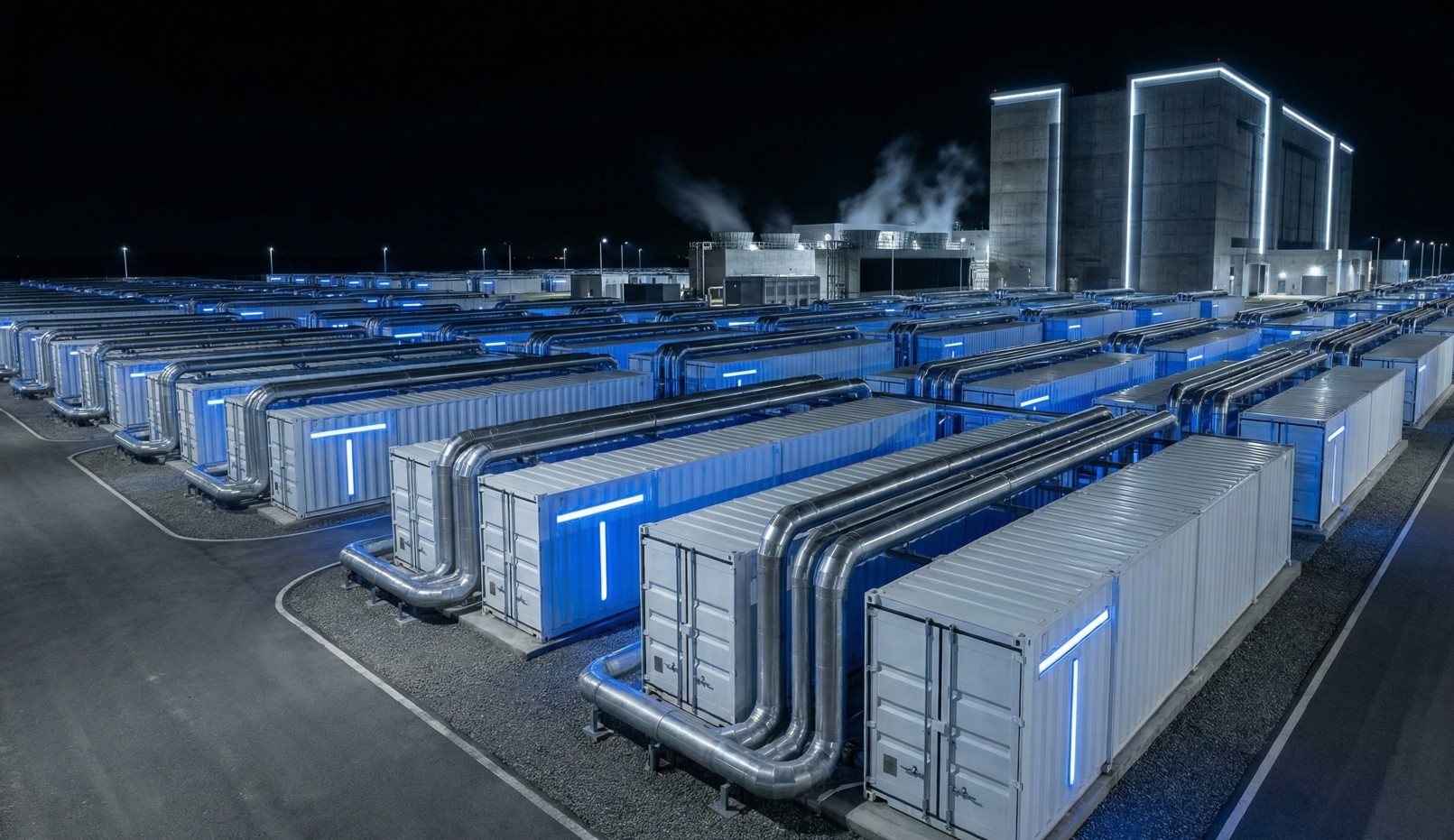
The New Era: Storage as a Cash Incubator
Bharat's strategic storage recalibration massively propels the Green Wave—quadrupling renewable impact to anchor absolute industrial sovereignty.
History is no longer a valid blueprint for Bharat’s energy future. The legacy era of simply scaling renewable capacity and hoping the grid can withstand the variance is over. We have entered the “AI Power Cycle”, a high-stakes industrial shift where electricity is no longer just a commodity but the primary feedstock for a trillion-dollar digital economy. As Bharat’s data centre capacity surges toward 1.7 gigawatts by the end of 2026, the requirement for 24/7 reliability has evolved from a policy goal into a non-negotiable industrial mandate.
The shift in the load has altered the dynamics of the game. AI-dense racks do not tolerate intermittency. Dr Rahul Walawalkar, the President of the India Energy Storage Alliance (IESA), recognises the present as the pivotal moment. The assumption that renewable energy deployment is too small to affect the grid is a legacy error. Today, DISCOMs are increasingly refusing to sign agreements for variable projects without a storage buffer. Battery Energy Storage Systems (BESS) have officially graduated from “nice-to-have” pilots to the core infrastructure of the national grid.
Monetising Stability
Walawalkar’s audit reveals that the historical lag in storage was a failure of market orchestration, not technology. For years, the value of storage was not monetised—there were no mechanisms to pay for frequency regulation or peak capacity. That structural gap is being terminated by the Union Budget 2026, which has increased the Viability Gap Funding (VGF) for BESS to ₹1,000 crore, a nine-fold escalation from previous years.
Walawalkar argues that storage must be treated as a grid reliability asset, not merely an energy arbitrage tool. “The most powerful nudge is long-term revenue certainty, not another short-term subsidy,” he notes. By providing 10-to-15-year visibility through capacity payments, Bharat is shifting the risk from technology to execution. This revenue allows private capital to flow into Long-Duration Energy Storage (LDES), ensuring that the grid can manage the massive surplus of solar hours and the brutal deficits of evening peaks.
Material Neutrality
The strategy for the Advanced Chemistry Cell (ACC) race is now defined by material neutrality. Bharat is not tethering its sovereignty to a single chemistry. Lithium Iron Phosphate (LFP) serves as the practical backbone for current utility-scale BESS, offering superior safety and avoiding dependence on cobalt and nickel. However, the true “India Edge” lies in the maturation of sodium-ion technology.
Sodium-ion batteries, with their abundant materials and exceptional heat tolerance, are an ideal choice for Bharat’s tropical operating environment. Walawalkar emphasises that, while the current market is dominated by imports, the development of domestic sodium-ion supply chains—supported by the latest customs duty exemptions for capital goods—will ultimately hedge against critical mineral volatility. We are choosing the right chemistry for the right use case, ensuring that our mobility and grid sectors remain resilient to global supply shocks.
The Urban Mine
The formalisation of a circular economy is anchoring strategic resilience. By 2035, the first major wave of electric vehicle batteries will reach their second life. These retired assets are not waste; they are urban mines. If Bharat treats battery recycling as industrial infrastructure rather than waste management, recycled lithium, nickel, cobalt, and copper can offset a significant portion of mineral imports by the next decade.
“Countries that recycle will manage supply chain risks. Those that don’t will remain exposed,” Walawalkar warns. The National Critical Minerals Mission is now incentivising the recovery of valuable materials from our cities. This internalisation of the mineral loop ensures that the transition to green energy does not create a new form of import dependence. The molecule is recovered, refined, and returned to the furnace, closing the sovereign loop.
Global South Standard
Through NETRA, Bharat is developing a modular, safety-first storage architecture engineered for real-world constraints: heat, dust, and cost sensitivity. This “Made in India” framework is becoming the default standard across Africa, Southeast Asia, and Latin America. India understands these harsh operating conditions better than any developed market.
Walawalkar’s vision is to shift the nation from a technology adopter to a global leader. Bharat is exporting its industrial expertise by standardising the design, financing, and recycling of storage in the Global South. This is the final act of the energy transition: orchestrating a global ecosystem that connects R&D, supply chains, and manufacturing to avoid the duplication of legacy efforts.
The Verdict
The sheer velocity of the digital load has settled the storage debate. We are no longer discussing the “cost” of the battery but the price of inaction. The grid is now a sentient, balanced machine, buffered by domestic chemistry, and secured by long-term fiscal visibility. The intermittent era is dead. Bharat has achieved Total Grid Command.
Solutions Spotlight
Storage as a Cash Incubator: Five Mechanisms
- • Capacity Payments: Structure 10–15-year revenue certainty agreements for BESS grid assets—shift risk from technology to execution
- • Ancillary Services Market: Enable BESS to monetise frequency regulation, peak shaving, and spinning reserve—converting stability into revenue
- • LDES Investment Framework: Create specific financial instruments for Long-Duration Energy Storage beyond 4-hour cycles to address the Duck Curve
- • Second-Life Battery Infrastructure: Formalise the urban mine—mandate EV battery repurposing for stationary storage before primary recycling
- • NETRA Global South Standard: Export the Made-in-India modular BESS architecture to Africa, Southeast Asia, and Latin America as the default standard
Key Takeaways
- • DISCOMs refusing variable projects without storage buffers marks the inflection point: BESS is now grid-mandatory, not grid-optional
- • The ₹1,000 crore VGF nine-fold escalation is not a subsidy—it is a market-making signal that unlocks private capital at scale
- • Long-term revenue certainty (capacity payments) is more powerful than any short-term subsidy—it converts BESS from pilot to permanent infrastructure
- • Sodium-ion’s tropical heat tolerance makes it the ideal Indian grid chemistry: abundant materials, no cobalt, engineered for our climate
- • The urban mine—second-life EV batteries in stationary storage—closes the sovereign mineral loop and delays the need for primary extraction
Strategy Note
The storage debate is settled. The AI Power Cycle has made 24/7 grid reliability a hard industrial constraint, not a policy preference. The ₹5,400 crore VGF and the nine-fold BESS increase are the starting gun. The institutions that deploy the right chemistry, structure long-term revenue certainty, and formalise the urban mine will own the grid spine for the next two decades.