
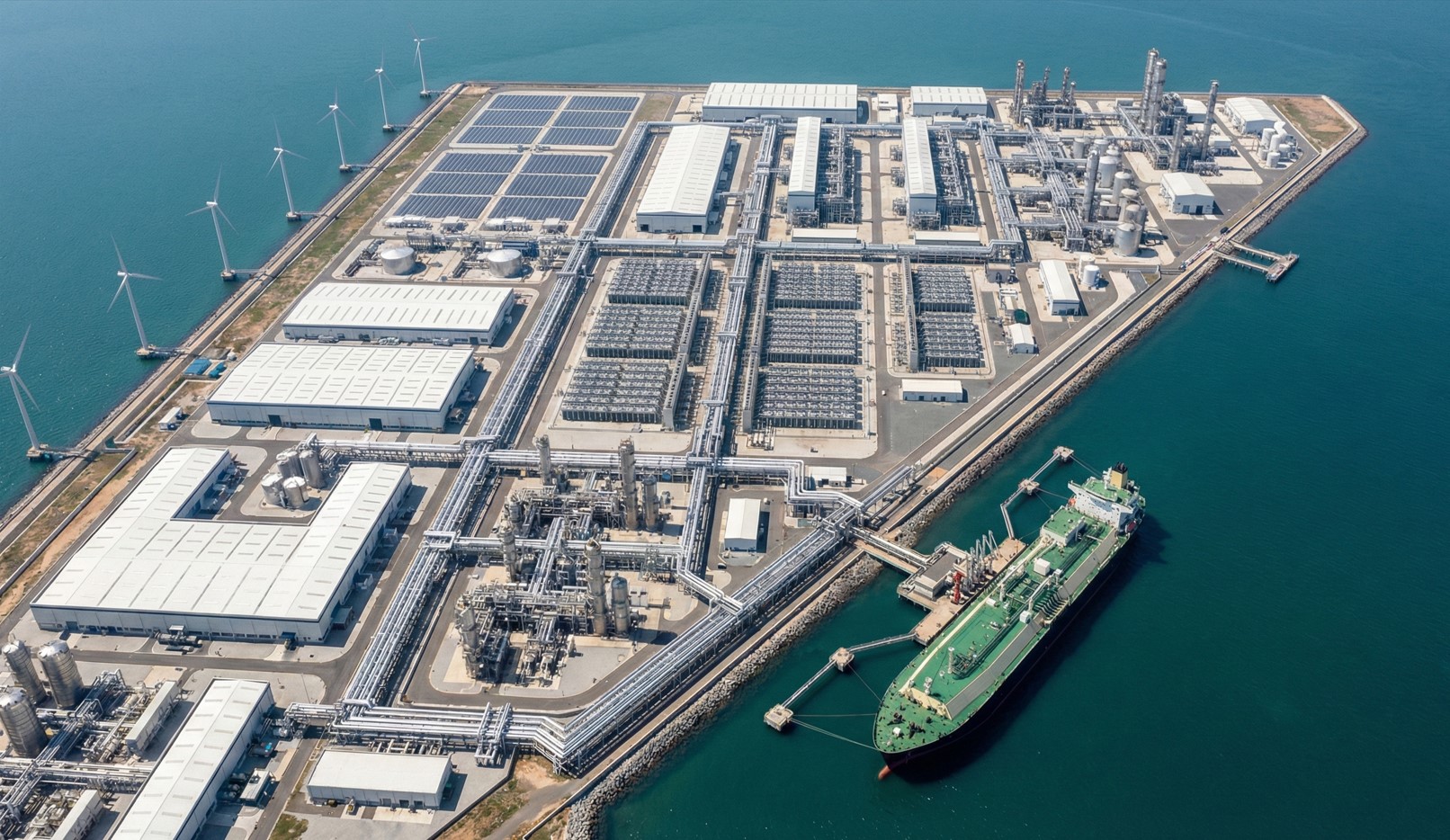
Vande Giga Hubs: Redefining Global Green Order
Bharat secures industrial dominion by instantiating a sovereign network of integrated clusters—fusing energy with manufacturing to anchor maximum yield.
The romantic phase of the energy transition has matured into a definitive industrial reality. The early era of dispersed solar farms connected by long-distance transmission has evolved into a sophisticated logic of “industrial concentration”. The sector has graduated from “Project Development” to “Territorial Possession”. The mandate now extends beyond transmitting power across the subcontinent; the objective is to capture it, bundle it, and fuse it into a single, sovereign giga-cluster. In this new landscape, the molecule does not travel. The factory is built inside the furnace.
This shift represents the instantiation of industrial dominion. Co-locating the entire green value chain within a unified footprint eliminates the legacy bottlenecks of transmission loss and logistical friction. Success in this sphere ensures that Bharat possesses the most cost-competitive industrial engine on the planet.
Utility Metamorphosis
Gurdeep Singh, Chairman and Managing Director of NTPC, stands as the primary architect of this transformation. His blueprint for the Pudimadaka Green Hydrogen Hub in Andhra Pradesh represents a ₹1.85 lakh crore commitment to industrial permanence. This nexus integrates 20 gigawatts of dedicated renewable capacity with a production engine capable of delivering 1,500 tonnes per day (TPD) of green hydrogen.
Singh views this project as the logical evolution of the thermal power giant. He is leveraging the scale of a legacy utility to “firm up” the intermittency of the Green Wave. By bundling solar, wind, and pumped hydrogen into a single “plug-and-play” cluster, NTPC provides heavy industry with absolute operational uptime. The giga-hub model solves the fundamental challenge of renewable energy: reliability. By physically placing the electrolyser next to the power source, the facility bypasses the national grid entirely. Such a “zero-loss” integration saves the 15-20% of energy typically lost during transmission, converting efficiency directly into margin.
Molecular Closure
Vineet Mittal, Chairman of Avaada Group, offers the “Sand-to-Molecule” mandate. This strategy replaces traditional reliance on global supply chains with total domestic ownership. His plan for the Gopalpur Industrial Park calls for the energy stack to be fully vertically integrated. The process begins with manufacturing the polysilicon and wafers and ends with producing the final green ammonia molecule.
Mittal argues that true sovereignty lies in “Molecular Closure”. This concept dictates that every input capability must be owned domestically. Avaada’s strategy creates a defensive moat against global commodity shocks by controlling the manufacturing logic of the hub itself. Operating in this “Island Mode” ensures that the cost of the final molecule is determined by domestic efficiency rather than foreign volatility. Owning the supply chain allows Bharat to decouple its energy security from external geopolitical fluctuations.
Engineering Execution
Subramanian Sarma, Whole-time Director (Energy) at L&T, anchors the engineering reality of these giga-clusters. As the builder of the world’s largest hydrogen infrastructure, Sarma’s blueprint focuses on the “Execution Moat”. The transition from policy to production requires a mastery of high-complexity engineering, procurement, and construction (EPC).
L&T’s mandate involves the fabrication of gigawatt-scale electrolysers and the digital integration of the entire molecular flow. Sarma views the Giga-Hub not merely as an asset, but as a precision machine that must operate at 99.9 per cent reliability. His focus on “productive decarbonisation” shifts the narrative from environmental compliance to hard industrial engineering. Such a level of technical rigour is essential. Handling high-pressure hydrogen requires a safety and precision standard that far exceeds traditional power generation. L&T’s deployment of advanced digital twins allows for the real-time monitoring of every valve and compressor, ensuring that the physical asset matches the financial model.
Maritime Intercept
Ashwani Dudeja, the Group President at ACME Group, stands out as a pioneer in the global export industry. Having secured the first major green ammonia offtake agreement with Japan’s IHI Corporation, Dudeja’s blueprint focuses on the “commercial horizon”. His strategy secures long-term, fixed-price contracts, rendering the giga-hubs financially viable even before they lay their first foundation.
Establishing the “Odisha-to-Tokyo” green corridor proves that Indian hubs can compete globally based on landed costs. Dudeja’s approach validates the commercial logic of the hub model: build at scale, secure the trade route, and anchor the export market. The ability to sign these binding agreements signals to global finance that Indian green hydrogen is a tradable commodity, not a speculative venture.
Port Refineries
Sarbananda Sonowal, the Union Minister for Ports, Shipping, and Waterways, anchors the maritime aspect of this sovereignty. Under the Maritime Amrit Kaal Vision 2047, the nation’s ports are being re-engineered. They are evolving from “passive logistics gateways” to “active energy refineries”.
Sonowal’s mandate involves the creation of “green shipping corridors” that connect Bharat’s giga-clusters to the global market. Developing the ₹76,000-crore Vadhvan Port and dedicated green bunkering hubs at Deendayal and Tuticorin allows the nation to define the terms of the global maritime transition. Possession of the “molecule moat” ensures that the value of the green hydrogen produced in the hinterland is captured at the port gate. Ports are no longer just transit points; they are now value-added centres where green ammonia is stored, blended, and fuelled for the next generation of global shipping vessels.
Industrial Symbiosis
Dr Praveer Sinha, CEO and MD of Tata Power, champions the concept of the “decentralised giga-cluster”. He argues that the future of competitive manufacturing lies in private industrial houses building their own sovereign energy ecosystems. Tata Power’s move toward providing Firm and Dispatchable Renewable Energy (FDRE) is the ultimate execution play.
Sinha’s blueprint focuses on eliminating the “heat tax” on industry by delivering 24/7 clean power at a fixed, long-term tariff. FDRE combines solar, wind, and battery storage to provide a constant flow of electricity, mimicking the reliability of a coal plant without the carbon. Industries such as steel and cement require constant power; intermittent solar is insufficient. Tata Power’s model bridges this gap, ensuring that green energy can power the heaviest industrial loads without interruption.
Physical Inventory
The consolidation of these hubs marks the end of “green extractivism”, where emerging nations merely export raw molecules. Bharat is now focused on the high-value upstream—manufacturing the electrolysers, the fuel cells, and the high-precision chemistry within the hub itself. Establishing this “industrial nucleus” allows for the immediate conversion of green hydrogen into green ammonia, green urea, and sustainable aviation fuel (SAF). Every metre of pipe and every tonne of storage within the cluster adds to the national balance sheet of intellectual and physical property. The roadmap to 2035 is no longer a set of targets; it is a physical inventory of assets. The hubs are locked. The possession is absolute. The machine is in motion.
Solutions Spotlight
Vande Giga Hubs: Five Execution Mandates
- • Commission the Pudimadaka Green Hydrogen Hub (20 GW renewable + 1,500 TPD) as the blueprint template for all subsequent giga-clusters
- • Implement ‘Molecular Closure’ in all new hubs—from polysilicon manufacturing to green ammonia synthesis within a single integrated footprint
- • Mandate zero-loss integration: every hub must co-locate electrolysers with power source, bypassing national grid transmission losses
- • Secure binding offtake agreements (Odisha-to-Tokyo corridor model) before construction begins to de-risk the commercial case
- • Re-engineer ports (Vadhvan, Deendayal, Tuticorin) as active energy refineries with green bunkering, ammonia storage, and SAF blending
Key Takeaways
- • The hub model solves renewable energy’s fundamental flaw: reliability. Zero-loss co-location converts 15-20% transmission savings directly into margin
- • Gurdeep Singh’s Pudimadaka (₹1.85 lakh crore, 20 GW + 1,500 TPD) is not a project—it is the template for territorial industrial possession
- • Vineet Mittal’s ‘Sand-to-Molecule’ mandate at Gopalpur creates a closed-loop hub immune to global commodity shock—the Island Mode moat
- • Ashwani Dudeja’s Japan IHI offtake agreement proves the commercial logic: secure the trade route before laying the first foundation
- • Ports are no longer logistics gateways—they are active energy refineries where green ammonia is stored, blended, and bunkered for global shipping
Strategy Note
Territorial possession is the new energy strategy. The era of dispersed solar farms is over. The Vande Giga Hub is not infrastructure—it is a sovereign industrial fortress. Build inside the furnace. Own the molecule. Capture the export lane. The roadmap to 2035 is a physical inventory of assets, not a policy document.