
Vande Mobility: Orchestrating Green Kinetic Velocity
Bharat is actively eliminating its 14 per cent logistics burden, proving that the legacy era of slow, fossil-heavy transit is extinct.
Bharat is actively eliminating its 14 per cent burden from logistics, proving that the legacy era of slow, fossil-heavy transit is extinct. In the context of the “Global Green Wave”, this historical 14% was not merely an economic tax; it was a massive carbon penalty. We are ruthlessly decarbonising the global supply chain. Nations that cannot move goods cleanly will face insurmountable trade barriers. We have entered the phase of kinetic mastery. The movement of industrial assets is now a sovereign competitive advantage, not a friction point. As Bharat scales toward a $10 trillion economic reality, sustaining logistics costs at a single-digit 9% of GDP is a non-negotiable mandate.
This transition is not happening by accident. It is being architected at the highest levels of state and industrial capacity. Three stellar blueprints are currently defining the macro-trajectory of this kinetic intercept.
Architecting Grid Velocity
Nitin Gadkari, Union Minister for Road Transport and Highways, is engineering the physical circulatory system of the Green Wave. His blueprint targets the complete eradication of the ₹22 lakh crore yearly cost of fossil fuel imports. Gadkari is moving beyond simple road construction, driving an unprecedented 100 kilometres per day while simultaneously upgrading 25,000 kilometres of legacy highways.
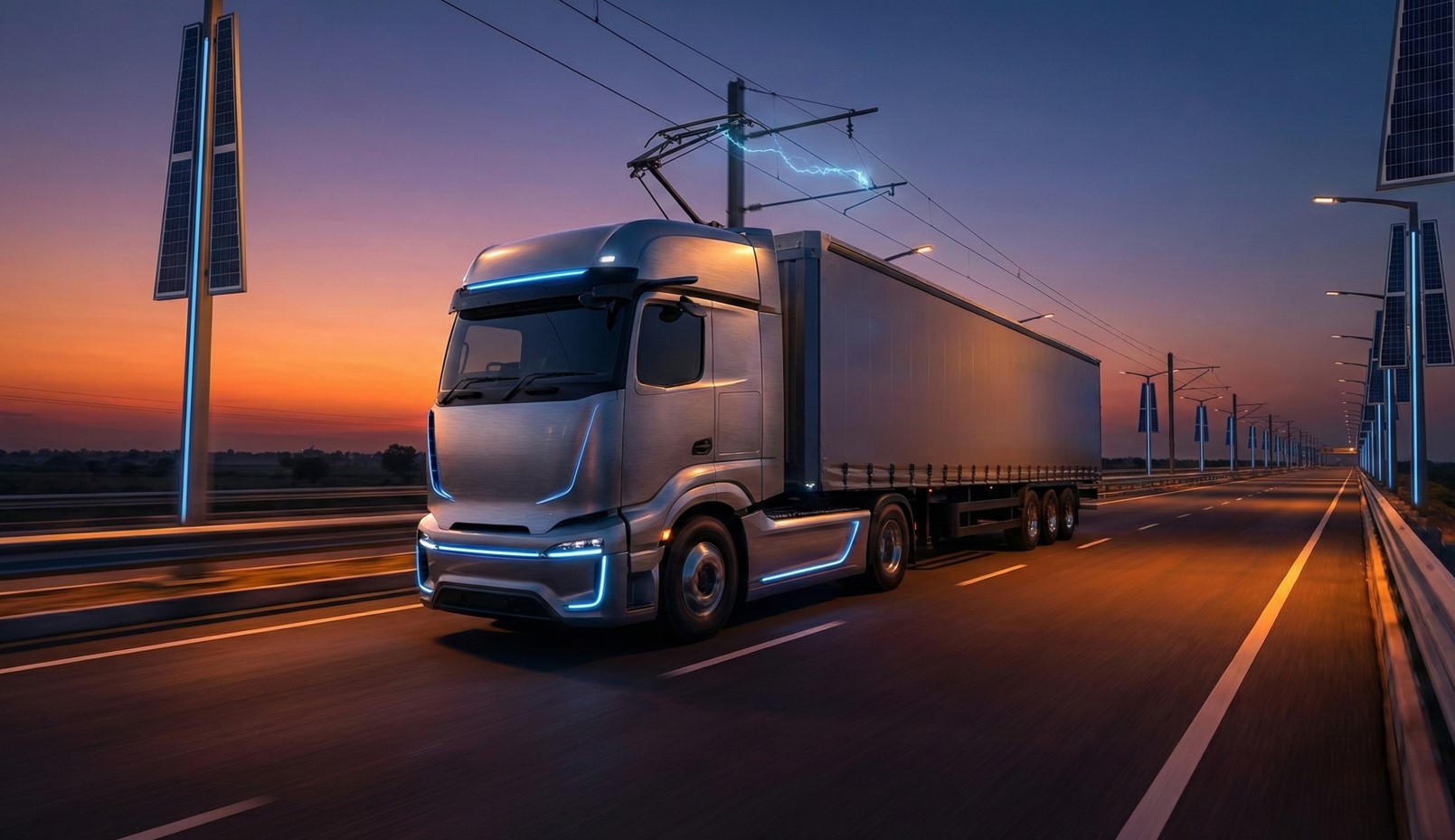
The e-highway mandate is the centrepiece of his strategy. Gadkari is actively formalising stretches of the Delhi-Jaipur and Delhi-Mumbai corridors with overhead solar and wind-powered catenary lines. This allows heavy trucks to draw power directly from the grid while in motion. It bypasses the battery weight penalty that has historically plagued heavy-duty electric transport. Gadkari is creating a high-speed economic hub with zero emissions by integrating these e-highways with digital tolling and a multi-fuel vision.
Anchoring Hardware Realism
Dheeraj Hinduja, Chairman of Ashok Leyland, is formalising the hardware resilience required to populate Gadkari’s grid. His blueprint is defined by technological realism. While the world waits for expensive hydrogen fuel cells to become bankable, Hinduja has spearheaded the development of the Hydrogen Internal Combustion Engine (H-ICE) in collaboration with Reliance Industries.
This is a masterstroke of industrial pragmatism. H-ICE allows fleet operators to transition 19-to-35-tonne heavy trucks to clean hydrogen using slightly modified diesel engine architectures. It keeps capital expenditure low and ensures rapid market entry. Hinduja is simultaneously scaling pure electric output, inaugurating a cutting-edge, 5,000-vehicle capacity EV plant in Lucknow in just 14 months. This vision ensures Bharat is entirely self-reliant in manufacturing the precise commercial multi-fuel assets needed for a tropical operating environment.
Securing Maritime Nodes
Sarbananda Sonowal, the Union Minister for Ports, Shipping, and Waterways, is anchoring the maritime terminus of the Green Wave. His blueprint aggressively aligns with the Maritime Amrit Kaal Vision 2047. Far from a passive policy document, the framework serves as a massive ₹80 lakh crore sovereign mandate designed to quadruple port capacity while forcing absolute carbon neutrality across all major coastal nodes.
The mandate ensures that the clean momentum generated on land is not immediately lost at sea. Sonowal is terminating this vulnerability. He is effectively sealing the handover point between the highway and the ocean, orchestrating a 30% reduction in carbon emissions per tonne of cargo by 2030.
His strategy hinges on establishing “green shipping corridors” with global heavyweights like Singapore and Rotterdam. Domestically, he is converting V.O. Chidambaranar, Paradip, and Deendayal ports into sovereign hydrogen bunkering hubs. By integrating over 12 million metric tonnes of green hydrogen-based e-fuel capacity directly at the ports, Sonowal is ending the traditional diesel bunkering model. Bharat is now the primary green refuelling node connecting the Eastern and Western hemispheres.
Execution on Ground
Policy sets the trajectory; private enterprise dictates the velocity. The blueprints of Gadkari, Hinduja, and Sonowal provide the framework, but the “true kinetic intercept” is being implemented on the ground by a new echelon of execution architects. The logistics debate is being terminated by the physical deployment of sovereign assets.
The Last Mile and the Heavy Haul
Mahesh Babu, the managing director of Olectra Greentech, is orchestrating the mass decarbonisation of Indian streets. His blueprint replaces the diesel heart of public transit with a high-efficiency electric pulse. With a staggering target of delivering 5,000 electric buses by the close of 2026, Babu is executing the most aggressive fleet transition in the Global South. Olectra has already clocked over 500 million green kilometres. Through the PM E-DRIVE scheme, Olectra demonstrates that high-capex green mobility is bankable at the municipal level. The electric bus is the new default standard.
Vellayan Subbiah, the vice chairman of Tube Investments of India, is driving the structural recalibration of 40-tonne heavy trucking. Through TI Clean Mobility and its Montra Electric brand, Subbiah has infused a massive ₹750 crore investment. His blueprint solves the “payload-to-battery ratio” via a rapid battery swapping architecture. By executing a swap in under six minutes, Montra eliminates the charging downtime that logistics operators despise. Heavy trucks now maintain 95% uptime, proving sustainable freight outcompetes diesel in sheer operational efficiency.
Anirudh Bhuwalka, CEO of Blue Energy Motors, is the primary architect of the transition fuel logic. Recognising that two million long-haul trucks cannot switch to pure electricity overnight, Bhuwalka is orchestrating the LNG-to-hydrogen bridge. His ₹3,500 crore investment to establish a 30,000-truck capacity plant in Maharashtra is a definitive industrial statement. By establishing the Mumbai-Pune corridor as India’s first LNG logistics highway, Blue Energy slashes carbon intensity by 30% immediately.
Maxson Lewis, Managing Director of Magenta Mobility, is mastering the final, most chaotic leg: last-mile delivery. Lewis is ending urban inefficiency by formalising green deliveries for retail giants like Amazon and DHL. Having clocked over 2 crore electric kilometres, Magenta proves that light commercial vehicles can handle the brutal demands of the Indian retail grid. The driver-owned, driver-operated model makes green logistics bankable at the micro-level. The last mile is no longer a bottleneck; it is a carbon-neutral sprint.
Digital Synchronisation
The physical orchestration of these vehicles is entirely dependent on the digital instantiation of PM Gati Shakti. Infrastructure is useless without synchronisation. The Unified Logistics Interface Platform (ULIP) serves as the sentient brain of the kinetic grid. It seamlessly integrates FASTag, GPS, and e-way bills into a single, transparent data layer.
When a Blue Energy heavy truck leaves a factory, transfers cargo to a Montra electric tractor at a Multimodal Logistics Park, and hands off to a Magenta delivery van, it is guided by predictive intelligence. This eliminates the manual interventions that cause dwell time at ports and state borders. We are not just moving metal; we are transmitting high-value data.
Sovereign Verdict
The “mobility intercept” is complete. Bharat has successfully decoupled economic momentum from imported crude oil. By formalising a multifuel, digitally synchronised grid, the nation is turning the logistics drag into a “massive capital incubator.” The e-highways are charging. The maritime hubs are bunkering hydrogen. The digital brain is active. The “global green wave” has achieved absolute “kinetic supremacy” on Indian soil.
Solutions Spotlight
Vande Mobility: Five Kinetic Actions
- • E-Highway Fast-Track: Commission Delhi-Jaipur and Delhi-Mumbai catenary corridors by 2027, enabling zero-emission heavy trucking without battery weight penalty
- • H-ICE Scale: Mandate Hydrogen ICE adoption for 19-to-35-tonne trucks as the immediate transition vehicle, keeping capex low for fleet operators
- • Port Carbon Mandate: Enforce 30% carbon reduction per tonne of cargo at major ports by 2030 under Maritime Amrit Kaal Vision 2047
- • Battery Swap Infrastructure: Deploy rapid swap stations (6-minute swap) at every major National Highway node for Montra-class heavy electric trucks
- • ULIP Integration: Full FASTag-GPS-e-way bill synchronisation across all Multimodal Logistics Parks to eliminate dwell time and border friction
Key Takeaways
- • The 14% logistics cost burden is simultaneously a carbon penalty and a margin tax—collapsing it to 9% of GDP is the kinetic sovereign mandate
- • Gadkari’s e-highways with catenary lines bypass the battery weight penalty for heavy trucking—zero-emission freight without the engineering compromise
- • H-ICE is the pragmatic bridge: hydrogen in slightly modified diesel engines keeps capex low and fleet transition velocity high
- • Montra’s 6-minute battery swap maintaining 95% truck uptime proves electric heavy freight is operationally superior to diesel, not just greener
- • ULIP’s predictive intelligence converts the last-mile handoff from a dwell-time bottleneck into a seamless, digitally-guided carbon-neutral sprint
Strategy Note
The mobility intercept is not a single vehicle transition—it is the decoupling of India’s $10 trillion economic momentum from imported crude oil. Gadkari’s e-highways, Hinduja’s H-ICE, Sonowal’s port carbon mandate, and Lewis’s last-mile grid are the four walls of the kinetic fortress. The ULIP is its nervous system. When all four walls stand simultaneously, the Green Wave achieves kinetic supremacy.