
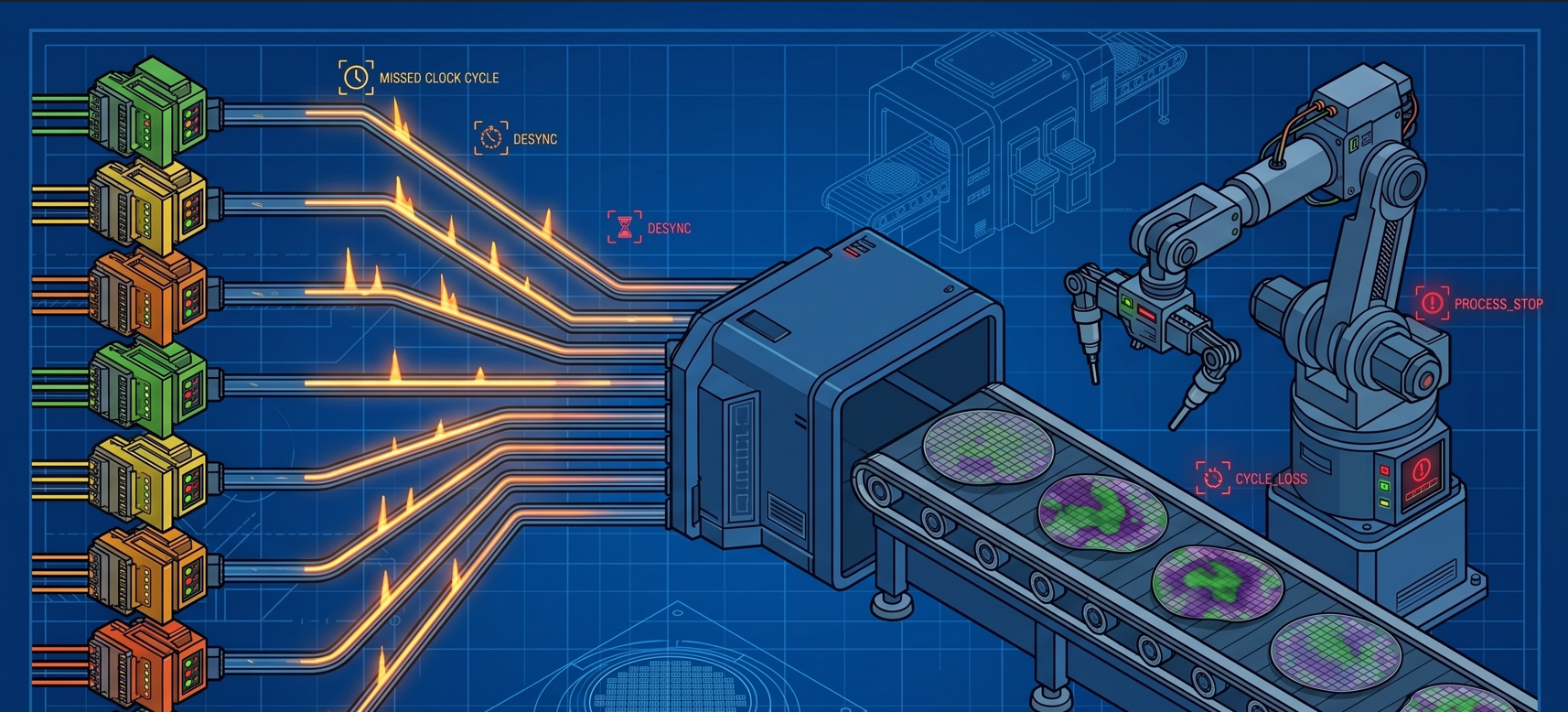
Missed clock cycles, desync, process stop: how grid instability ends manufacturing contracts
Line trips.
Voltage drops.
Machines desync.
Batch is gone.
Uptime Rule
Manufacturing runs on uptime. Not power. Power available is not power usable. When a high-tech assembly line runs, it demands absolute frequency stability and unyielding voltage consistency. A momentary dip is not a pause. It is a catastrophic event. Chemical processes corrupt. The entire batch in the chamber is ruined. Uptime is the unbroken continuity of stable electrons—a constraint Praveer Sinha, CEO, Tata Power, frames in industrial grid design. Power breaks. Shipment misses.
Failure Cycle
Look at a Tier-1 electronics assembly failure. The facility was capitalised. The orders were locked. The workforce was trained. But the localised grid carried a fractional instability. A 15-minute outage triggered a 48-hour recalibration cycle for the surface-mount lines. The line didn’t stop for 15 minutes. It lost two days. The defect rate spiked from 0.01% to 15%. The immediate shipment was missed. The subsequent SLA was breached. The machines held. The grid didn’t. The contract moved.
Industrial Grid
Global manufacturing does not operate on shared municipal power. It operates on dedicated industrial grids engineered for 24/7 load assurance. This requires heavy infrastructure: dual-feed substations, massive uninterruptible power supply arrays, and localised generation buffers. The standard is not “mostly on”. The standard is six nines—near-zero downtime. Below that threshold, defects spike. Lines reset. Orders move. Without the industrial grid, you are running precision manufacturing on municipal tolerances.
01
Generation
Adds capacity to the system.
02
Grid
Holds frequency. Delivers consistency.
03
Storage
Absorbs failure. Bridges the gap.
04
SLA
Enforces uptime. Anchors the contract.
Cost of Uptime
Uptime is not cheap. Moving from 99% to 99.999% reliability doesn’t add cost linearly. It multiplies it. The last 0.9% costs more than the first 99%. When an industrial park relies on diesel generators and massive battery banks to bridge the gap of an unreliable primary grid, the landed cost of power per megawatt-hour skyrockets. This structural disadvantage erodes the margin before the first product rolls off the line. Vaibhav Chaturvedi, CEEW, puts it plainly: at scale, uptime costs more than power.
Energy is Chemistry
The defence mechanism against grid failure is shifting from combustion to chemistry. Storage is the new arbiter of uptime. Industrial loads don’t wait for generation. They draw instantly from buffers. Those buffers are chemistry. Energy flow is set at the anode and the cathode. Control doesn’t sit at generation. It sits at storage—a shift Vikram Handa has built his stack around. Whoever commands the storage chemistry commands the uptime buffer.
India Has Capacity. Not Consistency.
The macro data shows massive generation capacity additions. The grid is expanding. But aggregate capacity masks localised fragility. India has capacity. It doesn’t have consistency. High-value manufacturing corridors are still forced into high dependency on localised backup systems. The state provides power. The factory manufactures its own uptime. This structural gap forces capital away from core production and into redundant energy infrastructure. The factory builds products. And its own grid.
The Fix
- →Separate industrial load from city power.
- →Put storage in the base layer, not as backup.
- →Buy uptime. Not electricity.
- →Price contracts on uptime, not kilowatt-hours.
Miss uptime once, and you lose the shipment.
Miss it twice, and you lose the contract.
Strategy Note
The Energy Stack
- —Generation adds capacity.
- —Grid holds frequency.
- —Storage absorbs failure.
- —SLAs enforce uptime.
Key Takeaway
Laws That Hold The Contract
Analysis series · Issue 4 · India Front
Law I · Design
Spec Decides. Factories Follow.
Cost gets you in. Control keeps the contract.
Law II · Power · You are here
Miss Power. Lose the Line.
Stability holds output. Output holds contracts.
Law III · Precision
Miss Tolerance. Lose the Contract.
Quality isn’t a range. It’s a gate.
Law IV · Production
Nothing Fails For The First Time In Production
Discover it in production, you designed it wrong.
Edition Close · Delivery
No SLA. No Order.
Delivery holds the contract. Miss the cycle, and it reallocates.