
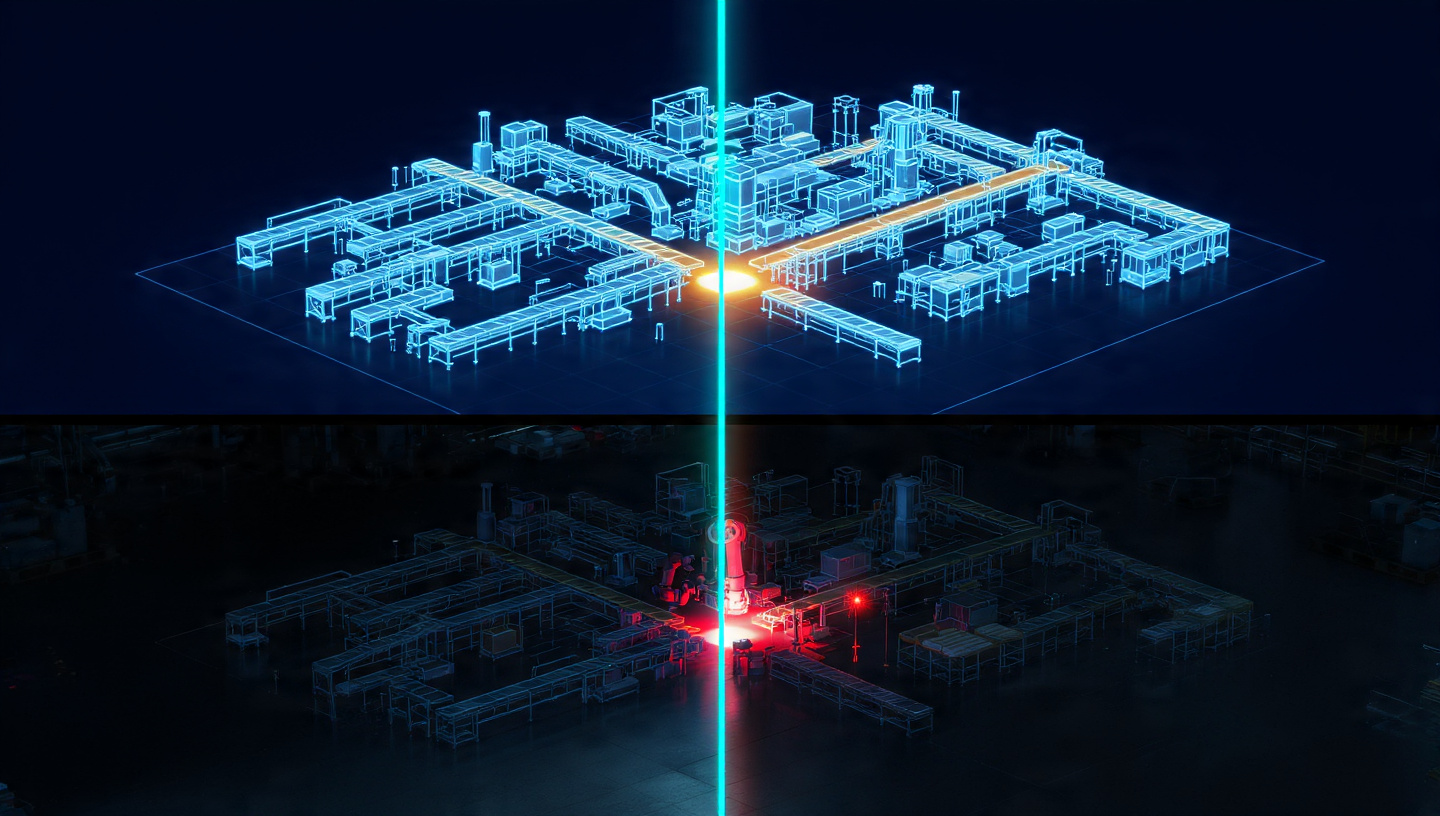
The factory exists twice — the virtual twin above, where failure is simulated into extinction; the physical below, where unmodelled risk becomes production loss
Production is the audit.
Failure is set before the run.
The floor only reports it.
Production Is Not Discovery
Production is not where you learn. It’s where you pay. Failure does not originate on the shop floor. It is presented there. If a line stops, the error was committed months prior. Nothing fails for the first time in production. It fails because the design space was left unmapped. Production is the final, irreversible audit.
Variance Is Designed In
“Unexpected downtime” is an unmodelled interaction. Line imbalance, thermal drift, and machine mismatch are not acts of God. They are omissions.
When a high-speed assembly line desynchronises due to thermal expansion, it is not a glitch. It is an instability that existed in design space. The shop floor just made it visible. Every failure in production already existed in design; physical reality reports it. If the causal chain—unmodelled condition leading to instability—is not broken in software, it will break the factory.
The Factory Exists Twice
The factory is an execution of a solved system.
“The factory exists twice.”
Jensen Huang
The first factory is virtual. A digital twin where variance is simulated into extinction. You do not build to test; you test so you can build. In a solved system, physical commissioning is a ceremony of confirmation (not discovery). The hardware is simply the final skin of a validated software model.
Virtual · The First Factory
The system is solved here.
Variance is removed before the build begins.
Physical · The Second Factory
This is execution, not discovery.
The floor runs what the model proved.
When You Skip the First Factory
Skipping the virtual factory forces the physical factory to become a debugger. Unmodelled processes lead to rework. Rework creates delay. Delay misses the allocation cycle.
Production teams solving design errors is system failure. Every hour of runtime debugging is a design failure paid for in public. While the floor struggles to stabilise lines, the allocator moves the volume to a geography that modelled the risk.
Kill Failure Before It Exists
Every method removes a class of failure. Digital twins eliminate integration failure before a bolt is turned. Simulation cycles remove thermal drift and line imbalance by stressing the model through environmental variables. API-led orchestration locks machine compatibility through unified communication protocols.
“What is modelled doesn’t fail.”
Time Decides Allocation
Time loss is contract loss. Every unmodelled failure translates into a missed delivery cycle. Missed cycles lead to lost allocation.
The first 90 days define reliability perception. You don’t lose contracts when things fail; you lose them when they fail late. If output is not predictable, volume moves.
India Problem — Commissioning in Concrete
India doesn’t model enough to prevent failure. It commissions in concrete; the world’s leaders commission in code.
On Indian shop floors, design flaws surface during the first run, leading to weeks lost stabilising lines that should have been solved in simulation—turning the first production cycle into a public debugging phase that signals unreliability to the allocator. This destroys the first reliability signal. The first 90 days decide if the next order ever arrives.
Threshold — The Rule
Model it, or pay for it.
Simulate it, or debug it in public.
Discover it in production, you designed it wrong.
Strategy Note
- Model it before the concrete is poured.
- Simulate failure before the line runs.
- Commissioning confirms. It does not discover.
- The first 90 days decide the next order.
Final Condition
Variance can be eliminated.
Delivery cannot be delayed.
Miss the window, and it reallocates.
Laws That Hold The Contract
Analysis series · Issue 4 · India Front
Law I · Design
Spec Decides. Factories Follow.
Cost gets you in. Control keeps the contract.
Law II · Power
Miss Power. Lose the Line.
Stability holds output. Output holds contracts.
Law III · Precision
Miss Tolerance. Lose the Contract.
Quality isn’t a range. It’s a gate.
Law IV · Production · You are here
Nothing Fails For The First Time In Production
Discover it in production, you designed it wrong.
Edition Close · Delivery
No SLA. No Order.
Delivery holds the contract. Miss the cycle, and it reallocates.