
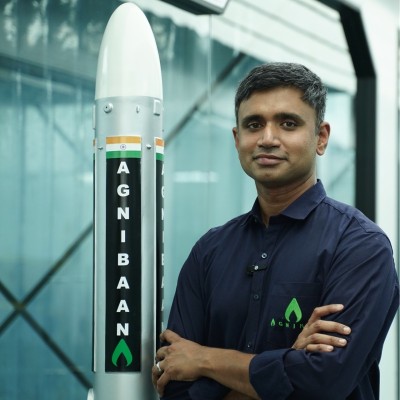
The Rocket Is Not The Asset
India's space debate often treats the launch vehicle as the prize. Reach orbit, and the mission appears complete. That is the deep-tech margin trap: access earns a fee, infrastructure captures the rent. Srinath Ravichandran starts from another layer. Agnikul Cosmos is not trying to remain a rocket company. It is building toward a space infrastructure company.
When Agnikul's plans for space-based AI data centres were read as a pivot into computing, Ravichandran corrected the frame. "I don't think it's a pivot. It's more of an extension," he says. The idea did not arrive with the latest AI power shortage debate. It came from an older engineering and business question: what else can the rocket hardware do after it has delivered the satellite?
The launch vehicle is the access layer. If a nation or company only provides access, it competes on price, not ownership. The owned asset sits behind the launch: the mission system that continues to operate after the boundary of space is crossed. That asset is the mission stack: single-piece engine IP, flexible launch architecture, clustered control, upper-stage conversion, and orbital platform potential.
MISSION STACK CONVERTS LAUNCH INTO INFRASTRUCTURE
The Convertible Stage
Once the payload separates, the upper stage has usually completed its commercial job. The hardware may be deorbited, moved away, or left with no further role. Ravichandran sees a value leak hiding in that convention. "It is effectively, from a business standpoint, wasted hardware," he says.
Agnikul's ownership move is to extend the commercial life of the upper stage after satellite separation. Hardware that would otherwise be discarded becomes a platform capable of another economic function. By designing the stage for functions such as energy conversion, thermal management and platform use, Agnikul turns spent launch hardware into a revenue-bearing orbital infrastructure asset.
The same launch event now carries two economic lives: payload delivery first, infrastructure use after. Hosting an AI data centre is one proposed application of this platform logic. Ravichandran's point is narrower than the buzzword: if the upper stage can manage energy conversion, heat dumping and platform hosting, the discarded stage becomes infrastructure. The deeper argument is structural: the launch event no longer ends at payload separation. The upper stage becomes a second economic life in orbit.
Globally, the same direction is visible: launch companies are moving up the stack from transport into spacecraft platforms, orbital services, communications networks and data layers.
DOCTRINE
The Convertible Asset
Payload → Orbit → Stage Conversion → Platform → Revenue
The Printed Engine
The single-piece printed engine is easy to mistake for manufacturing novelty. Ravichandran's point is more practical. The engine is printed in a single shot with no conventional process in between because Agnikul's market demanded a different production logic.
For Agnikul, the manufacturing problem was scale-specific. Techniques that work for larger engines become economically painful when the engine is smaller and the mission model demands responsiveness. Smaller launch vehicles cannot inherit the economics of large conventional propulsion. Fabrication at that scale forces a choice: accept high manual complexity, or create a new production method.
The printed engine improves the reliability proposition by removing assembly steps, reducing human intervention and making repeatability part of the process itself. Process becomes IP when repeatability is designed in, not inspected in. It also strengthens the promise of rapid launch response and shorter customer waiting times.
ENGINE IS REPEATABILITY
The Flexibility Moat
Large rockets solve one problem well: moving mass at scale. Agnikul is solving another: giving small-satellite customers a launch that fits their payload, timing and orbit.
For small satellites, flexibility is not a convenience. It is the market. Ravichandran emphasises that this flexibility is the core differentiation against larger rockets. Heavy-lift vehicles operate like freight trains, asking payloads to fit fixed schedules and shared trajectories. Agnikul's model is closer to the cab: smaller, available, precise and configurable.
The cab does not beat the train by becoming larger. It wins by serving a different access problem. High-margin IP sits in configurable access: mission size, waiting time, launch location, price envelope and orbital requirement. When the customer dictates the timing, the mission architecture must bend to the payload, not the other way around.
FLEXIBILITY IS MARGIN ARCHITECTURE
That flexibility requires modular control, not only smaller hardware.
The Repeatability System
A single engine test proves a component. A cluster test proves behaviour.
A mission stack must coordinate multiple propulsion units at once, managing the physics of liftoff through control. Ravichandran's cluster logic is specific: each engine is locally governed, but globally coordinated. The engines must look and feel the same while onboard control manages the cluster as one vehicle. The ownership layer is not the flame. It is the control architecture that makes multiple engines behave as one vehicle.
Flexibility becomes economically useful only when clustered control and repeatability are built into the stack. Quality is not startup hustle. Quality is marathon behaviour. In aerospace, speed without traceability leaks value through reliability failures. Repeatability depends on documentation, automation, flagging and the ability to apply brakes without slowing the whole system.
By tracking metrics continuously and reducing human variation, Agnikul makes reliability a property of the system rather than an act of individual vigilance.
DOCTRINE
The Mission Stack
Engine IP → Launch Flexibility → Upper-Stage Conversion → Orbital Platform → Space Infrastructure
The Ownership Shift
India must move from launch participation to mission-stack ownership. The practical task is to fund mission-specific infrastructure, build volume-ready launch authorisation, deepen domestic vendor capability, and reward repeatable launch economics.
Deep-tech scale needs patient capital and government-backed risk capital. Value capture will come from rapid launch cadence, customer-specific timing, and upper-stage platform economics — not from launch price alone. For Ravichandran, government-backed risk capital also sends a signal to global markets: India is building design, not just services. Early-stage funding has improved. Growth capital for hardware-heavy space ventures still demands investors who understand long validation cycles.
Capital and policy still cannot secure the market by themselves. Ravichandran warns that deep-tech founders can get "lost in the technology jungle," focusing on engineering perfection while losing sight of commercial viability. A mission stack is not owned because it works in the lab. It is owned when it answers a customer need repeatedly, at a price and cadence the market recognises.
Hard design discipline must be paired with customer discipline. That is how technical capability becomes commercial reality.
Ravichandran's long-term direction is clear: Agnikul wants to move beyond transport and become a full-stack space infrastructure company. The next Indian space advantage will come from companies that convert launch, process, control and orbital hardware into owned infrastructure. If India reaches orbit without owning the mission architecture, launch remains a transaction and value exits through foreign-owned platform software, ground-station networks, cloud aggregation layers and customer interfaces.
The country that owns only the launch sells a service. The country that owns the mission stack owns the infrastructure logic of orbit.
Ownership Law
Own the mission stack, or remain a launch vendor.
More from Issue 5 · Own the IP